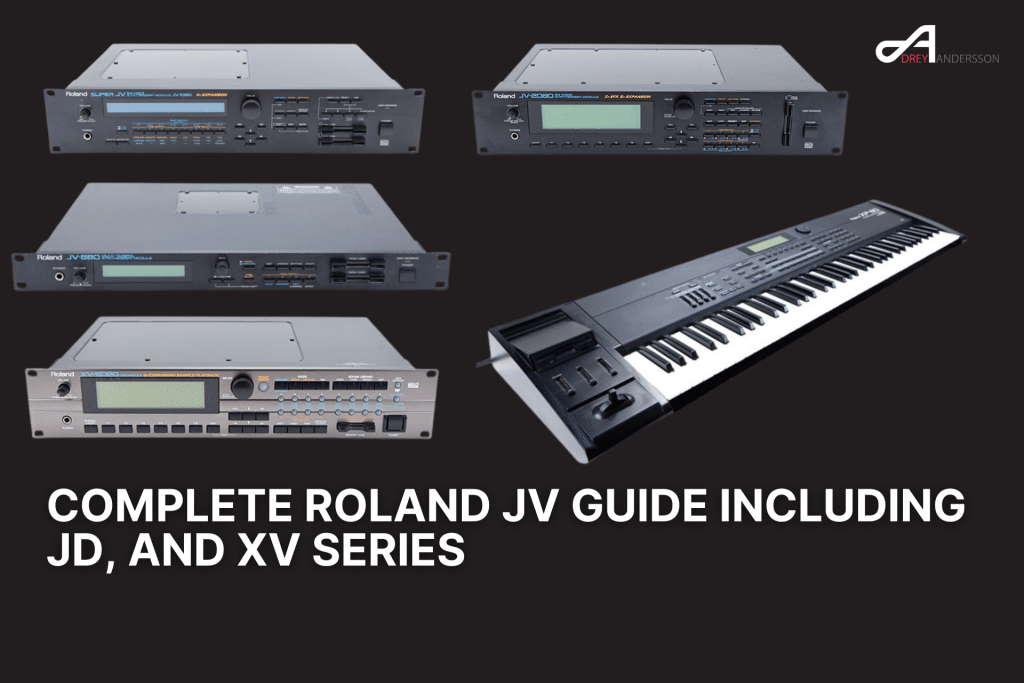
When I picked up my JV-880 about ten years ago for 70 bucks off eBay, I was a student with more curiosity than budget. In 2026 I added a JV-2080 to my rack, and I promptly fell down the same rabbit hole all over again: forum threads, archived FAQs, scattered blog posts, conflicting opinions. Which DACs sound warmer? Why does my 880 handle expansion boards differently than my 2080? Are the capacitors in SR-JV80 cards really about to fail? The information exists, but it’s fragmented across dozens of sources, some dating back to the late ’90s.
This guide is the article I wished existed when I started. It consolidates everything I’ve learned from hands-on comparison between my own units, countless hours of research, and long nights with the technical documentation. Whether you’re eyeing your first vintage Roland rompler, choosing between models, or keeping existing gear alive in 2026, it covers the full picture: the JD, JV, and XV families, how they actually sound different, every SR-JV80 expansion board, and the modern Romulator and Wi-Fi cards that keep the ecosystem breathing.
No more twenty browser tabs. One guide.
Key takeaways
- Roland itself calls the JV-1080 the most-used module synth in history (Roland), and working units still list for just €295-399 on Reverb in July 2026.
- The families really do sound different: the JD series runs 44.1kHz through Burr-Brown PCM61-family DACs, while the entire Super JV line runs 32kHz (Don Solaris FAQ).
- Roland’s 2017 advisory told SR-JV80 owners to stop using unchecked cards; two modern reprogrammable cards, the £64 Sector101 Romulator and the $68 SR-JV Wi-Fi card, have become the practical fix.
- Cheiron Studios stacked “four or five” JV-1080s and JV-2080s for the Britney and Backstreet Boys records (MusicRadar, 2021).
Where did the JV family come from?
Three families, one decade: the JD-800 arrived in 1991, the JV-1080 conquered studios from 1994, and the XV-5080 closed the arc in 2000 with 128 voices (Vintage Synth Explorer). Between those bookends, Roland built the sound of mainstream pop, trance, drum and bass, and late-90s video games.
The story starts with a complaint. By 1990, digital synths had become menu-diving exercises, and Roland’s answer was radical for its time: the JD-800 put 59 sliders and buttons back on the panel, a direct descendant of the company’s LA-synthesis era but with hands-on control the D-50 never offered. It was also the first product designed jointly by Roland Japan and the R&D team in Los Angeles, where chief sound designer Eric Persing worked (Roland Articles). Persing’s line about it still sums up the design brief: “This is a synthesizer, and it makes synthesizer sounds.”
These instruments remain viable production tools today, with a sonic character that software recreations still don’t fully capture. I’ll get into exactly why, with chip numbers, later in this guide. First, the map.
A word on how to read this: the guide runs from history to hardware to money. If you’re deciding what to buy, the model table below and the decision guide near the end will get you there fastest. If you already own a box and want to feed it expansion boards safely in 2026, jump to the SR-JV80 ecosystem and the two reprogrammable-card reviews. And if you’re here for the DAC arguments, the architecture section has the chip-by-chip breakdown the forums always promise and never quite deliver.
The family tree, 1991-2002: from JD-800 to XV-2020
Seventeen models in eleven years, and every one of them traces back to two decisions Roland made in 1991: sample-based synthesis with real filters, and (from 1992) a slot system for expansion boards (Vintage Synth Explorer). Here’s the lineage in one pass.
The JD branch (1991-1993). The JD-800 keyboard came first: 24 voices, 108 waveforms at 44.1kHz, and that glorious slider panel. The development story explains the character: it was the first product built jointly by Roland Japan and the small Los Angeles R&D team (Persing, Chris Meyer, Mark Tsuruta, Bob Daspit), it dedicated essentially all four megabytes of ROM to synthesizer waveforms rather than instrument imitations, and it ran keyboard and sound engine on separate processors for near-zero latency (Roland Articles). Even the panel got attention: digital parameters angled at 45 degrees, subtractive controls vertical, a layout you can read mid-performance.
The rack-mount JD-990 followed in 1993 and quietly became the family’s audiophile darling. It added oscillator sync, ring modulation, dual-oscillator structures, and a deeper modulation matrix, and it launched at £1,499 (Sound On Sound, June 1993). And in a detail that matters for everything below, the JD-990 got one SR-JV80 expansion slot, tying the JD sound into the JV ecosystem.
The first JV generation (1992-1993). The JV-80 keyboard and its 1U rack twin, the JV-880, targeted working musicians rather than sound designers: 28 voices, 32kHz playback, one expansion slot each. The 76-key JV-90 and the JV-1000 workstation (a JV-90 with an onboard MC-50mkII sequencer) rounded out the range in 1993.
The Super JV era (1994-1999). When the JV-1080 landed in January 1994 at £1,085, it changed the economics of professional sound: 64 voices, 448 waveforms, 16-part multitimbral operation, and four expansion slots in a 2U box (MusicRadar). Film and game composers adopted it as standard issue. The XP-50 (1995), XP-60 and XP-80 (1996) put the same engine under keyboards with sequencers; the JV-2080 (1997) doubled the slots to eight and added a big display; the half-rack JV-1010 (1999) squeezed the engine into a budget box with the Session board built in.
The XV finale (2000-2002). The XV-3080 and XV-5080 doubled polyphony to 128 voices and expanded the ROM to 1,083 waveforms, including 112 from the JD-990 (Vintage Synth Explorer). The XV-5080 went further: it loads Roland S-700 and Akai sample libraries over SCSI into up to 128MB of RAM, making it a genuine hybrid rompler-sampler. The XV-88 put the 3080 engine under 88 weighted keys, while the XV-5050 (2001) and XV-2020 (2002) closed the line with compact SRX-only boxes and USB.
Every model at a glance
The table below is the reference I wish I’d had years ago: every mainline JD, JV, XP, and XV model with its year, polyphony, expansion slots, and what working units actually list for in July 2026. Prices are asking prices observed on Reverb this month plus tracked averages where available; treat them as orientation, not gospel.
| Model | Year | Format | Voices | Waveforms | Expansion slots | Typical price, July 2026 |
|---|---|---|---|---|---|---|
| JD-800 | 1991 | 61-key synth | 24 | 108 | none (SL-JD80 card sets) | €1650-2999 working, €850 non-working; £1071 tracked sale avg (GearBook) |
| JD-990 | 1993 | rack | 24 | 195 | 1x SR-JV80 | €1150-1650 |
| JV-80 | 1992 | 61-key synth | 28 | 129 | 1x SR-JV80 | sparse listings; comparable to JV-880 |
| JV-880 | 1992 | 1U rack | 28 | 221 | 1x SR-JV80 + PCM card slot | €182-351 |
| JV-90 | 1993 | 76-key synth | 28 | n/a | 1x SR-JV80 (+VE-JV1 voice expansion to 56 voices) | sparse listings |
| JV-1000 | 1993 | 76-key workstation | 28 | n/a | 1x SR-JV80 (+VE-JV1) | sparse listings |
| JV-1080 | 1994 | 2U rack | 64 | 448 | 4x SR-JV80 | €295-399; £268 tracked sale avg (GearBook) |
| XP-50 | 1995 | 61-key workstation | 64 | 448 | 4x SR-JV80 | roughly JV-1080 territory (few clean listings) |
| XP-80 | 1996 | 76-key workstation | 64 | n/a | 4x SR-JV80 | from ~USD 477 (Equipboard, 2026) |
| JV-2080 | 1997 | 2U rack | 64 | 448 | 8x SR-JV80 | €380-690, serviced units €545-690 |
| JV-1010 | 1999 | half-rack | 64 | 448 | 1x SR-JV80 | €227-295 |
| XP-30 | 1999 | 61-key synth | 64 | n/a | 2x SR-JV80 | sparse listings |
| XV-3080 | 2000 | 2U rack | 128 | 1083 | 4x SR-JV80 + 4x SRX | from ~USD 349 (Equipboard, 2026) |
| XV-5080 | 2000 | 2U rack | 128 | 1083 | 4x SR-JV80 + 4x SRX | €574 clean Japan unit; €2390 loaded with expansions; eBay sold avg ~USD 356 |
| XV-88 | 2000 | 88-key | 128 | 1083 | 2x SR-JV80 + 2x SRX | sparse listings |
| XV-5050 | 2001 | 1U rack | 64 | 1083 | 2x SRX (no SR-JV80) | €300-364 |
| XV-2020 | 2002 | half-rack | 64 | 1083 | 2x SRX | around USD 250 (Equipboard, 2026) |
Two patterns worth noticing. First, polyphony tells you the generation: 24-28 voices means first generation, 64 means Super JV, 128 means XV flagship. Second, the used market has decided that the JD branch is collectible while the Super JV branch is a workhorse bargain. Whether the JD premium is justified by sound is exactly what the next section digs into.
Why do the JD, JV, and XV series sound different?
Because Roland changed three things between generations: the sample rate (44.1kHz for JD, 32kHz for the entire JV/XP line), the DAC chips (at least seven different converters across the family), and the ROM compression scheme (Don Solaris FAQ). Musicians consistently report that different models sound noticeably different on identical patches, and for once the folklore has chip numbers behind it.
Most of what the community knows here traces to one remarkable document: Don Solaris’s “Ultimate Roland JV, JD, XV F.A.Q.”, which compiled converter data and insights credited to Roland’s own former chief sound designer Eric Persing. I’ve verified the FAQ’s claims against chip datasheets and service documentation where possible, and I’ll flag which parts are measured fact and which are informed opinion as we go.
The converter table: which chip is in your Roland?
This is the family’s digital-to-analog conversion at a glance, per the Solaris FAQ. The chips themselves are documented in Burr-Brown, NEC, and AKM datasheets; the PCM61P, for instance, is an 18-bit serial-input audio DAC that was a genuinely premium part in 1993.
| Model | Sample rate | DAC |
|---|---|---|
| JV-80 | 32kHz | 18-bit Burr-Brown PCM69P |
| JV-90 | 32kHz | 18-bit Burr-Brown PCM69AU-1 |
| JV-880 | 32kHz | 18-bit Burr-Brown PCM69AP (main out), NEC uPD6376GS-E2 (sub out) |
| JV-1080 | 32kHz | 18-bit NEC uPD63200GS-E2 |
| JV-2080 | 32kHz | 18-bit Burr-Brown PCM69AU |
| XP-30 | 32kHz | 24-bit AKM AK4324 |
| XP-50 | 32kHz | 18-bit NEC uPD63200GS-E2 |
| XP-60 | 32kHz | 18-bit Burr-Brown PCM69AU |
| XP-80 | 32kHz | 18-bit Burr-Brown PCM69AU |
| JD-800 | 44.1kHz | 18-bit Burr-Brown PCM61 |
| JD-990 | 44.1kHz | 18-bit Burr-Brown PCM61P |
Notice the pattern: everything JV and XP runs at 32kHz regardless of chip, both JDs run at 44.1kHz, and the one oddball is the XP-30 with its 24-bit AKM converter. More on that below.
What does the JD-990’s 44.1kHz architecture actually buy you?
CD-quality bandwidth, basically. At 44.1kHz the Nyquist limit sits at 22kHz, so the JD-990’s Burr-Brown PCM61P converters can deliver genuinely extended high-frequency response with wide stereo imaging. That’s the “crystalline” top end programmers rave about when building bell tones, metallic textures, and high-frequency modulation effects. The JD-990’s resonant filter can also push into self-oscillation without harsh digital artifacts, which is a big part of why sound design people treat it as the family’s crown jewel.
There’s a trade-off in the filter, though. Push resonance past roughly 40% with filter key-tracking maxed and complex chords in certain ranges can drive the filter into harsh clipping. The XV series later fixed exactly this with more filter headroom and a pre-filter oscillator gain control, at the cost of what some ears hear as a slightly more polite character.
Why does the 32kHz JV series sound “warm”?
Because of what happens at the edges. Running at 32kHz puts Nyquist at 16kHz, and the anti-aliasing filters in these units weren’t brick-wall designs. Content near and above the limit folds back into the audible range, a mirror effect that adds subtle harmonic complexity many engineers describe as analog-like warmth. It’s not nostalgia; it’s aliasing behaving musically. The debate over whether that beats clean conversion is basically the does-analog-sound-better argument transplanted into the digital domain.
The converters add their own seasoning. The JV-1080’s NEC uPD63200GS-E2 tends to read slightly darker and more mix-friendly, while the JV-2080’s Burr-Brown PCM69AU presents marginally cleaner and more forward. Users report the difference is real in A/B tests and subtle enough to vanish in a dense mix. Solaris himself asked readers to send him recordings because he couldn’t verify it side by side, which tells you how fine this margin is.
And the XP-30? On paper its 24-bit AK4324 should embarrass the 18-bit units. In practice many users report it sounds thinner than a JV-1080. Implementation beats bit depth: the surrounding circuit matters more than the converter’s spec sheet, a lesson that applies to modern audio interfaces just as well.
The compression question: what’s actually in the ROM?
All of these modules store waveforms compressed. The scheme is Adaptive Differential PCM (DPCM), which encodes the difference between consecutive samples rather than absolute values, achieving roughly 2:1 to 4:1 compression while dedicated hardware expands playback back toward 16-bit resolution in real time. It’s why 8MB of ROM in a JV-1080 sounds far bigger than “8 megabytes” suggests. The reverse-engineering community has since confirmed the ROMs use non-linear storage; the VirtualJV project has to descramble the JV-880’s waveform ROM before it can play a note (giulioz/jv880_juce).
Then there’s the contested part. Solaris wrote that beyond DPCM he “always suspected (but never got it 100% confirmed)” that the Super JV and XV series apply an extra, possibly destructive layer of compression, MP3-like holes visible on an analyzer, while “JD uses Adaptive DPCM and no destructive compression (no data holes)”. I’m quoting rather than asserting because nobody has published measurements that settle it. If true, it would explain why the JD-990 keeps its premium despite offering fewer waveforms than an XV-5080. In a busy mix, though, even Solaris’s camp concedes most engineers can’t reliably tell which module played which track.
How do the XV boxes change the recipe?
The XV generation mixes rates: the XV-5080 and XV-5050 carry the original 44.1kHz JD-990 waveform set alongside the 32kHz JV legacy content, while the XV-3080 plays the JD material at 32kHz (Solaris FAQ). That’s an underrated buying detail: if you want the JD set at full bandwidth in a rack, the 5080 delivers it and the 3080 doesn’t.
One more Solaris observation worth carrying: the XV-5050 “has some sort of permanent low shelf filter at about 30 Hz, so you’ll definitely get a less bass energy”, paired with spectacular high-frequency response through its digital output. Treat the 30Hz claim as reported rather than measured; a Vintage Synth Explorer forum thread comparing the 5050 and 5080 found no filter difference beyond DSP limits, so ears disagree here. What’s less controversial is the dynamic behavior: users consistently report the 5050 holding output levels noticeably steadier, which flatters dance music and flattens evolving film-score pads. Choose accordingly.
Filters and anti-aliasing: the other half of the character
The filter lineage runs JD-990 to Super JV to XV, and each step traded edge for control. The JD-990’s resonant filter is the prized one, edgy at high resonance and capable of self-oscillation without harsh artifacts, with slightly more high-frequency extension that programmers hear as sweetness in bells and filter sweeps. Its documented flaw, the clipping behavior under extreme resonance with maxed key-tracking, is exactly what the XV series engineered away with extra headroom and pre-filter gain control. The result: XV filters you can push anywhere without distortion, at the cost of a marginally politer voice. Neither is wrong. They’re different tools.
Anti-aliasing followed the same arc. The original JV-80/880 generation filtered laziest, letting the most mirror-effect content through, which is why those early boxes carry the grittiest vintage character. The Super JV series tightened it considerably, and the XV series essentially finished the job. If you want polish, buy late; if you want attitude, buy early. That’s the whole map in one sentence.
What do these differences mean for your genre?
Concretely, from my own use and the community’s accumulated experience:
- Film and TV scoring: the JD-990’s dynamic range and extended top end suit evolving pads that need to breathe; the JV-1080’s darker balance sits behind dialogue without fighting it.
- Electronic dance music: the XV-5050’s consistent output level and forward presence cut through dense mixes with minimal processing; what pad-lovers call squashed, a techno producer calls pre-glued.
- Pop and R&B: the JV-2080’s balance, cleaner than the 1080 and warmer than the XVs, covers strings-to-synth-bass duties from one box, which is precisely how the Cheiron team used theirs.
- Experimental and sound design: the JD-990’s sync, ring mod, and modulation depth enable sounds the JV/XV engines simply can’t make; pair it with creative aliasing from an early JV and you’ve got a character section, not just a rompler.
So the honest summary: the differences are real, measurable, and small. Signal chain, effects, and mix decisions will swamp them. But if you’re choosing one box to keep forever, the chip table above is the tiebreaker knowledge nobody puts on the spec sheet.
The records these boxes built
Roland’s own marketing calls the JV-1080 the most-used module synth in history (Roland), and for once the hyperbole holds up when you trace the credits. These modules didn’t just appear on hit records; in a few genres they practically were the sound.
Start with Cheiron Studios in Stockholm. In a 2021 MusicRadar interview, Rami Yacoub, Max Martin’s production partner on the Britney Spears and Backstreet Boys records, laid it out: “the Roland JV-1080 and JV-2080. We had about four or five of them in a stack,” and “The 2080 was the main synth at Cheiron. We had all the expansion cards and that’s mainly what we used for the stabs and the pads.” He added, “Every time they released a new expansion card we just ran after it!” The layered stabs and pads that defined turn-of-the-millennium pop came out of exactly the boxes this guide covers.
Electronic music tells the same story from another angle. LTJ Bukem, Photek, and London Elektricity were all documented JV-2080 users, the lush jazzy pads of intelligent drum and bass owing plenty to those 32kHz strings (Wikipedia). Faithless built “Insomnia”-era atmospheres on JV-series hardware too; I’ve pulled apart that famous pizzicato lead in my Insomnia sound recreation if you want the hands-on version.
The JD-800 belongs to the keyboard players. Tony Banks bought one new while Genesis recorded We Can’t Dance, and “Hold On My Heart” leans on the factory preset Hearts of Space. Decades later, synth YouTuber Alex Ball bought Banks’ actual unit and found his Genesis tour patches still inside it (MusicRadar). Prince’s camp used the JD-800 across the Diamonds and Pearls sessions at Paisley Park (Guitarcloud).
And if you grew up on PlayStation, you already know these boxes by ear. Late-90s Japanese game scores standardized on the JV series; Metal Gear Solid, Resident Evil 2, and Final Fantasy Tactics all leaned on JV-1080s and JV-2080s, typically with the Orchestral expansion (Sonicstate, 2025). That specific blend of cinematic strings and synthetic texture is the JV’s fingerprint.
The afterlife might be the best part. Kevin Parker picked up a JV-1080 between Lonerism and Currents and told AudioTechnology: “An audiophile would think some of the patches are the cheapest, plasticky sounds. But for me they’re so romantically nostalgic. Because they’re the sounds I remember from when I was growing up in the ’90s.” Thirty years on, the cheap plastic sounds became the precious ones. Funny how that works.
Which model fits which producer?
Seventeen models, but really only six decisions, and price settles most of them: in July 2026 you can enter the family for under €250 (JV-880, JV-1010) or spend ten times that on a JD-800. Here’s my read on each branch after a decade with an 880 and now a 2080 in the rack.
JV-1080: the default answer
Four slots, 64 voices, the classic converter character, and the deepest used supply of any model here. At €295-399 on Reverb right now, with GearBook tracking sales around £268, it’s the sweet spot for a first vintage Roland. The slightly dark, mix-friendly balance suits everything from film cues to house stabs, and because Roland built so many, spares knowledge and patch banks are everywhere. Its one genuine annoyance is the non-standard rotary encoder, which is hard to source when it wears out. If you buy exactly one box from this guide, buy this one.
JV-2080: the comfortable answer
Same engine, eight slots, a display you can actually program on, and a third effects processor. Serviced units run €545-690, unserviced from around €380. This is what I added to my own rack in 2026, and the big screen genuinely changes how often you bother editing patches; the difference between squinting at two lines and seeing a patch laid out is the difference between tweaking presets and actually programming. With eight slots you can keep an orchestral setup and a dance setup resident simultaneously, which is exactly how Cheiron ran theirs.
JD-990: the sound designer’s answer
Oscillator sync, ring modulation, dual-oscillator structures, the deep modulation matrix, 44.1kHz conversion through PCM61P DACs, and one SR-JV80 slot. At €1,150-1,650 asking it costs three JV-1080s. If you mostly play presets, that money is wasted; if you program sounds from scratch, this is the best digital synth Roland ever made, and its filter’s edgy resonance behavior (self-oscillation without harsh artifacts, that documented clipping quirk at extreme settings) is a feature palette of its own. The Vintage Synth board was half-voiced specifically for the JD-990’s architecture, making it the natural first card.
XV-5080: the maximalist answer
128 voices, both board formats (four SR-JV80 plus four SRX), the full 44.1kHz JD-990 waveform set, 90 multi-effects, and SCSI sample loading into up to 128MB of RAM, which turns it into a hybrid rompler-sampler that reads Roland S-700 and Akai libraries (Vintage Synth Explorer). Clean units list around €574; loaded ones jump to four figures. It’s the most capable box in the family and the least “vintage”-sounding one, which is either the selling point or the deal-breaker depending on why you’re shopping. The XV-3080 gives you the same engine minus sampling, and remember it plays the JD set at 32kHz rather than 44.1kHz.
XV-5050 and XV-2020: the modern-convenience answers
The 1U XV-5050 (€300-364) trades expansion breadth (two SRX slots, no SR-JV80) for a 24-bit output stage, S/PDIF digital out, and USB. Its consistent, compressed-feeling output level suits dance music and its digital out into a DAW is genuinely spectacular for clarity; evolving cinematic pads breathe less than on a JV-1080, and Solaris’s reported 30Hz shelf means slightly less deep bass energy. The half-rack XV-2020 ($250ish) is the USB-editing successor to the JV-1010 niche.
JV-1010: the toe-dip answer
Half-rack, one slot, 64 voices, €227-295, with the Session board content already built in, which softens the single-slot limit considerably. The catch: serious programming needs computer-based editing, since the front panel is minimal. Perfect desk companion, frustrating main instrument. For a first taste of the JV sound on a shelf next to your interface, though, it’s hard to beat.
XP-50/60/80, JV-90/1000, and XV-88: the keyboard answers
The XP line is the JV-1080 engine with keys and Roland’s MRC-PRO sequencer: XP-50 (1995, 61 keys), XP-60 (1996, 61 keys), XP-80 (1996, 76 semi-weighted keys, a 16MB ROM and a big 320×80 display, from around $477 currently). The XP-30 (1999) skips the sequencer, carries two slots plus the Session, Orchestral, and Techno waveforms built in, and hides that oddball 24-bit AK4324 converter. The earlier JV-90 and JV-1000 (1993) are first-generation boxes with direct expansion access, and the XV-88 (2000) puts the XV-3080 engine under 88 weighted keys. All era keybeds deserve inspection; the degrading-adhesive problems I covered in the keybed guide apply across this generation.
The JV-880 problem: cheap for a reason
I own one, I’ve kept it for a decade, and I still have to tell you: at €182-351 the JV-880 is only half the bargain it appears to be, because of one workflow limitation buyers rarely discover before purchase. Let me save you the surprise.
What makes the 880 different from every later JV?
It predates the Super JV architecture, which shows in three ways. The filter is the original JV-80 design rather than the JD-derived one, with resonance in discrete “soft” and “hard” modes instead of a continuous 0-127 control; community measurements put maxed soft resonance around a JV-1080’s value of 44 and hard around 88. The anti-aliasing filtering is weaker, so transposed material shows more high-frequency mirroring, grit that’s either a flaw or a feature depending on your taste. And the factory ROM is smaller: 221 waveforms and 28 voices against the 1080’s 448 and 64.
Sound-wise, the 880 runs its main outputs through 18-bit Burr-Brown PCM69AP DACs, with a separate NEC converter on the sub outputs (Solaris FAQ). Users consistently describe it as warmer and more “analog” than later models; whether that’s the DACs, the filter, or the looser anti-aliasing is genuinely debatable, and probably all three. For most material, 28 voices is plenty outside dense orchestral work.
None of that is the problem. Honestly, the grittier character is why sound designers still seek these out. The problem is the slot.
Why is the single expansion slot such a trap?
It’s not the count; it’s the workflow. On a JV-1080 or 2080 you insert a board and every patch on it is immediately playable alongside the factory set. On the JV-880 (and JV-80), expansion patches must be manually loaded into the unit’s 64 user memory locations, in groups of 64, overwriting whatever was there. A 256-patch board like Vintage Synth therefore never fully “fits”: you load patches 1-64, and reaching 65-128 means reloading and losing the first batch unless you saved it to a memory card first.
The full ritual, for the record: UTILITY, Load Patch Group, select EXP, choose which block of 64, press ENTER, wait, repeat whenever you need a different block. Compare that to the 1080: insert board, done. This limitation applies only to the JV-80 and JV-880; from the JV-90 and JV-1000 onward, expansion patches are directly accessible.
The classic workarounds are all ugly. Original M-256E/M-512E memory cards are rare, and modern reproductions cost about as much as the whole unit. The 880 also takes older SO-PCM1-series data cards through two front slots, with the same manual-loading dance; treat that as a historical curiosity, not a feature. The one modern fix that genuinely helps: the reprogrammable cards covered below, which turn “reload 64 patches” into “swap a card in 30 seconds”, or with the Wi-Fi card, “upload a different board from the couch”.
So who should actually buy a JV-880?
Buy it if you’ll live mostly on the factory sounds, want the original JV filter and aliasing character for sound design, need a 1U space-saver, or collect the lineage. It also integrates into a modern DAW setup without fuss: solid MIDI implementation, and third-party editors take the sting out of the small display. Skip it if expansion boards are the point; the extra €100-150 for a JV-1080 buys double the polyphony, double the waveforms, four slots, and patches that just appear when you insert a board.
If you do go hunting: eBay carries the most listings with Japanese sellers usually offering the cleanest units (shipping adds $40-80), Reverb runs slightly pricier with better documentation and returns, and local classifieds occasionally cough one up from a downsizing weekend warrior. Test before money changes hands where possible: every voice triggers across the keyboard range, display legible (backlights fade), every button responds (tact switches fail), MIDI works on all channels, and the expansion slot functions with a board if you can bring one. Mine earns its rack space as a character box with one well-chosen card. As a board platform, it would drive me up the wall.
The SR-JV80 expansion ecosystem: all 22 boards
Roland shipped 19 numbered SR-JV80 boards plus three “Experience” promo cards, and the system became one of the company’s most successful strategies of the decade (Wikipedia). Each 8MB card added waveforms and complete patch banks to the host synth. In 2026 the desirable ones trade for real money: Vintage Synth from about $187, Techno from about $191, and Keyboards of the ’60s & ’70s is widely described as the most sought-after of the series.
| Board | Name | 2026 notes |
|---|---|---|
| SR-JV80-01 | Pop | |
| SR-JV80-02 | Orchestral | |
| SR-JV80-03 | Piano | |
| SR-JV80-04 | Vintage Synth | from ~$187 (Equipboard 2026); ~510 patches, half voiced for JD-990, half for Super JV |
| SR-JV80-05 | World | |
| SR-JV80-06 | Dance | Roland stopped distributing it over copyright problems; source of the Cheiron-era hits sounds |
| SR-JV80-07 | Super Sound Set | |
| SR-JV80-08 | Keyboards of the ’60s & ’70s | widely described as the most sought-after board |
| SR-JV80-09 | Session | built into JV-1010 and XP-30 |
| SR-JV80-10 | Bass & Drums | €228 listing (Reverb Jul 2026) |
| SR-JV80-11 | Techno | from ~$191 (Equipboard 2026) |
| SR-JV80-12 | Hip-Hop Collection | |
| SR-JV80-13 | Vocal | |
| SR-JV80-14 | Asia | |
| SR-JV80-15 | Special FX | |
| SR-JV80-16 | Orchestral II | |
| SR-JV80-17 | Country | |
| SR-JV80-18 | Latin World | |
| SR-JV80-19 | House Collection | |
| SR-JV80-97 | Experience III | promo/demo board |
| SR-JV80-98 | Experience II | promo/demo board |
| SR-JV80-99 | Experience | promo/demo board; 97-99 have patch-data incompatibility on JV-80/880 (waveforms accessible) |
A few boards deserve footnotes. Dance (06) is the infamous one: Roland stopped distributing it over copyright problems, and its stabs and hits are all over the Cheiron-era records; when Rami Yacoub said they “ran after” every new card, this is the family of sounds he meant. Orchestral (02) is the one film and game composers standardized on; many engineers still consider its strings some of the most beautiful digital patches ever shipped, and it’s the board behind that unmistakable late-90s console-game score sound. Session (09) matters to buyers because its content is built into the JV-1010 and XP-30, so those boxes come “pre-expanded”. And Vintage Synth (04) carries roughly 510 patches, half voiced for the JD-990 architecture and half for the Super JV line, which is why it works so well in both.
On the collector end, Keyboards of the ’60s & ’70s (08) earns its most-sought-after reputation with electric pianos, organs, and tape-era textures that predate the current lo-fi fashion by twenty years. Techno (11) and House (19) feed the current dance-revival demand, which explains their $190-plus floors. Hip-Hop Collection (12) was a staple of 90s R&B production, and Bass & Drums (10) currently lists around €228. The pattern: genre boards tied to living scenes appreciate; general-purpose boards (Pop, World, Piano) stay affordable and honestly deliver the most musical value per euro.
Which boards for which music?
If you’re filling limited slots (or deciding what to load onto a reprogrammable card first), match the board to the work rather than the collector market:
- Scoring and cinematic work: Orchestral (02) first, Orchestral II (16) second; add Vocal (13) for choirs and Special FX (15) for texture beds.
- House, techno, trance: Techno (11) and House (19) are the obvious pair, with Dance (06) the historically loaded wildcard if you can source an image or card.
- Pop and R&B: Session (09) covers bread-and-butter duties, Hip-Hop Collection (12) adds the 90s R&B palette, and 60s & 70s Keyboards (08) brings the electric pianos everything sits on.
- Sound design: Vintage Synth (04) on a JD-990 is the deepest well in the whole ecosystem; Special FX (15) rewards resampling.
- World and acoustic color: World (05), Asia (14), Latin World (18), and Country (17) are cheap, deep, and criminally underrated as resampling fodder.
The later SRX series (12 boards, from 2000) offered higher-fidelity content for the XV generation and beyond; the XV-3080/5080 take both formats, which is a real part of their value. SRX cards currently list around €199-246 on Reverb. The practical difference: SRX boards carry substantially more data per card with newer samples, while SR-JV80 boards carry the specific 90s character these machines are famous for, and only SR-JV80 images work with the Romulator and Wi-Fi cards below.
The capacitor problem: why Roland told everyone to stop
Here’s the part that turns a gear guide into a preservation story. In 2017 Roland Japan issued an advisory urging users to stop using SR-JV80 cards until they’ve been inspected, because the 100uF 6V electrolytic capacitors on many cards operate with almost no voltage margin and have leaked or failed outright after 25+ years. This wasn’t an overreaction; failures are documented across the community.
The fix is cheap if you act before the failure: replacement 25V-rated capacitors cost $1-5 per card, and bulk recapping services charge around $7 per card. The risk of doing nothing is not just a dead card, but a card worth $200 dying with your only copy of its content. Which brings us to the two devices that changed this whole situation.
The Sector101 Romulator: reprogrammable insurance for dying cards
The Romulator is an 8MB programmable card that can become any SR-JV80 expansion board, and in July 2026 it sells for £64 (about $80) per card or £139 with the USB programmer unit (Sector101, 2026). Given that Roland itself told users in 2017 to stop trusting original cards, I’d call it the single most important accessory in this whole ecosystem.
Think of it as a rewritable expansion card. Sector101, a UK company specializing in memory solutions for synthesizers, built it with the same electrical properties as Roland’s original cards, so you can fill every slot in your synth with Romulators without overload or stability issues. It works in every host that takes SR-JV80 cards: the JV-80, JV-90, JV-880, JV-1000, JV-1010, JV-1080 and JV-2080, the JD-990, the XP-30/50/60/80, the XV-88, XV-3080 and XV-5080, plus the Fantom FA-76.
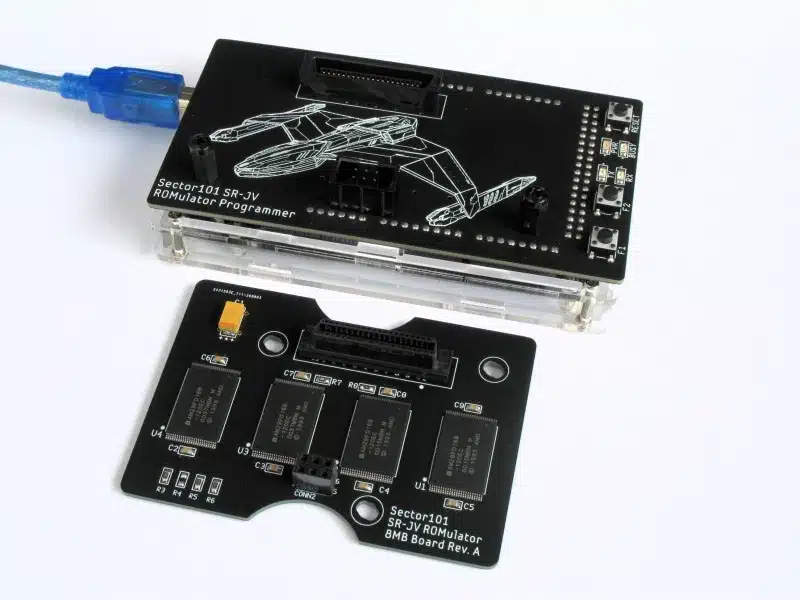
What does the Romulator actually do?
Three jobs. First, backup: the programmer unit reads your original SR-JV80 cards to .BIN files on your computer, so if a card dies you can recreate it exactly. Second, expansion: rather than paying $100-250 for a popular original board on the used market, you load whatever board image you need onto a Romulator. Third, custom waveforms: the card accepts experimental data, which is how the community reverse-engineered the SR-JV format in the first place. Sector101’s stated development goal was exactly that, unlocking the data format so custom waveforms and patches could run on Roland hardware that shipped decades before anyone imagined user content.
For JV-80 and JV-880 owners stuck with one slot and that manual patch-loading routine, there’s a fourth job. Keep two or three Romulators programmed with different boards and swap them physically. A 30-second card swap beats five minutes of menu-diving every time.
How does the programmer workflow feel in practice?
Honest answer: it’s a command-line affair, and that will filter some people out. The programmer plugs into USB, draws its power from the port, and talks to your computer through a terminal emulator, TeraTerm on Windows, with community-written guides for Mac (Serial by Decisive Tactics) and Linux (MiniCon). You type short commands: CD identifies whatever card sits on the programmer, read commands back up originals to .BIN files, write commands program a Romulator, erase commands clear it for new data. Sector101 publishes the full manual and software pack as free downloads and explicitly asks you to read them before buying. Do that. If a terminal window makes you nervous, look at the Wi-Fi card below instead.
One compatibility footnote from the current product page: the newest Romulator cards don’t work with early programmer units (serials RMPGM-001 through RMPGM-098). If you bought a programmer years ago, contact Sector101 about an upgrade before ordering bare cards.
What about creating your own expansion boards?
This is where it gets genuinely exciting for sound designers. Python Blue’s SR-JV ROM Hacking Kit, a free Python-based toolkit on GitHub, builds Romulator-ready .BIN images from new sample sets, with a YouTube walkthrough of the whole process. That opens doors Roland never built: expansion boards made from your own samples, hybrid boards combining waveforms from several SR-JV80 cards, or boards tailored to one production’s needs. If you’ve ever burned your own custom wavetables for an MPC, this scratches the same itch at 1990s Roland fidelity.
Sector101 also maintains a card image library for studying the SR-JV sample and patch format. Note the boundary they draw clearly: Romulators ship blank, never pre-programmed with Roland’s copyrighted card images. You back up cards you own, build custom images, or use the study library for research.
What does a full setup cost in 2026?
Current prices from Sector101’s site, with tracked international shipping included: one card plus programmer runs £159, a two-card kit £226, and additional bare cards £79 each (£143 for two, £209 for three). UK buyers pay slightly less since domestic delivery is cheaper. Payment is PayPal only, and Sector101 doesn’t ship to every country, so check the destinations list in their terms before you order.
Run the numbers on three common situations and the value proposition sorts itself out:
- Backing up a loaded JV-2080: a starter kit plus seven extra cards lands around £712 shipped, protecting eight original boards that would cost $800-1,600 to replace on the used market. Back up all eight to .BIN, program a Romulator with each, rack the Romulators, and store the originals safely.
- Budget expansion for a JV-1080: starter kit plus three cards, about £380, fills all four slots with whatever boards you need, against $400-1,000 for four original cards of the popular titles.
- JV-880 single-slot life: starter kit plus two cards, about £300, gives you three swappable boards and completely sidesteps the manual patch-loading ritual.
Break-even is simple: if you need two or more expansion boards, the Romulator system pays for itself, and unlike an original card it’s never obsolete. Reprogram it and it’s a different board.
The SR-JV Wi-Fi card: the $68 wildcard
Connor Zheng’s SR-JV Wi-Fi expansion card sells for $68 plus $6 base shipping as of July 2026, with the 9th production batch in stock (ddzheng.cc). It takes the opposite approach to the Romulator: instead of a faithful passive reproduction with an external programmer, it puts an ESP32 wireless microcontroller directly on the expansion board, so you reprogram it over Wi-Fi while it sits inside your synthesizer.
No programmer box, no pulling cards, no terminal emulator. The card carries 8MB of flash (the same capacity as an SR-JV80 card), a status LED, a USB-C connector for bench programming outside a synth, and a wake-up button. Designed by Zheng in Beijing on a 4-layer PCB, it’s fully open source, hardware and firmware both (GitHub).
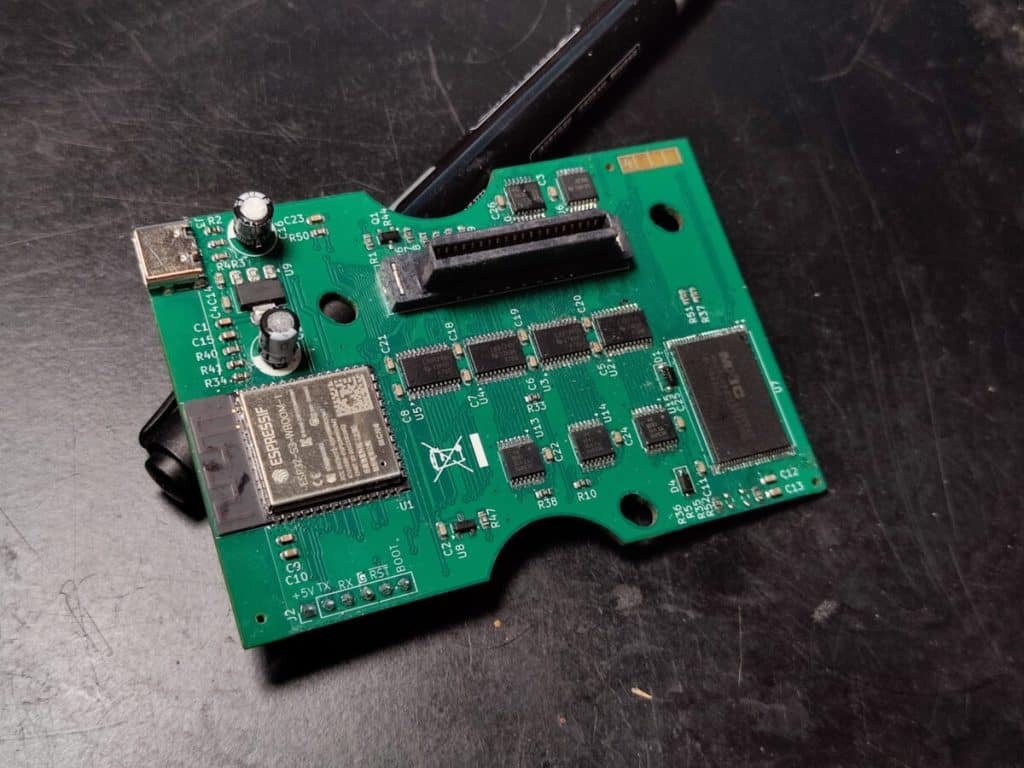
How does the Wi-Fi programming actually work?
The workflow is genuinely pleasant. Power the synth (or feed the card USB power on the bench), press the button, and the card broadcasts a hotspot named SR-JV-XXXXXX after the last six digits of its MAC address, no password by default. Join it, open 192.168.4.1 in any browser, and you get a plain web interface for ROM management, configuration, and firmware updates.
Programming a board image goes: erase flash (about a minute), choose your .BIN file, upload (a full 8MB takes about six minutes), then power-cycle the synth. Three practical rules from the maker’s guide that save you a failed flash: switch the synth’s current patch to something that doesn’t use the expansion card before erasing, keep the browser tab in the foreground during upload (laptop sleep and tab-switching are the usual culprits when uploads fail), and always do a full power cycle afterward rather than trusting a soft restart.
Firmware updates arrive over the air the same way: upload the new firmware .BIN through the web interface and the card reboots itself onto it. The safety engineering here is reassuring for a hobbyist product: invalid firmware files are rejected, a firmware that won’t boot triggers an automatic revert to the previous working version, and the ESP32’s boot ROM means a truly bricked card can still be reflashed through the production header with a USB-TTL adapter.
Where does it work, and where doesn’t it?
The convenience costs compatibility. The card reaches the host bus through voltage-shifting buffer ICs that add propagation delay, and in the tightest-timed slots that delay is fatal. The maker’s own compatibility matrix for the current hardware (Rev 1.2) breaks down like this:
| Status | Hosts |
|---|---|
| Fully compatible | JV-80, JV-880, JV-90, JV-1000, JV-1010, JV-1080, JV-2080, XV-3080, XV-5080, XP-30 |
| Works with conditions | JD-990 (wireless off required to remove interference); FA-76 (can’t mix card waveform with internal/SRX in same patch); XP-50/60/80 (slots A & B only) |
| Not compatible | XP-50/60/80 slots C & D (propagation delay – fundamental) |
| Untested (should work) | XV-88 |
The slot C/D limitation on the XP workstations is fundamental, not fixable in firmware. If you need all four slots filled in an XP-50/60/80, you need Romulators or original cards in C and D. The JD-990 works but demands wireless-off mode to keep RF whine out of the audio path, and the FA-76 can’t combine this card’s waveforms with internal or SRX waveforms inside a single patch. Zheng is refreshingly blunt about all of it, listing the exact situations where you “mustn’t purchase this product”, including anything needing maximum reliability on stage.
Hardware history, briefly, since old stock circulates: Rev 1.0 (Lot 1, datecode 2506) needed boot-time button workarounds on the JV-80 and JV-880; Rev 1.2 fixed that with faster 74AHC86/74LV86 address encoding and 74LVC1G125 chip-enable control. If someone offers you a used Lot 1 card cheap, the workaround instructions and a hardware mod are documented on the maker’s site.
What about power draw with multiple cards?
This is the one real operational rule. With Wi-Fi active the card draws 150-200mA, more while programming, against essentially zero for a passive original card. Several cards broadcasting simultaneously can pull 600-800mA from a 25-year-old 5V supply that never planned for it, enough to overheat it, trip protection, or worse. The firmware ships three power modes for exactly this reason:
- Always on: Wi-Fi permanently available. Fine for a single card, wrong for multiples.
- Wi-Fi off with BLE wake-up: 30-80mA average. The card sleeps with Bluetooth advertising; to wake it, open your phone’s Bluetooth settings and attempt to pair with the device named like the Wi-Fi SSID. The pairing fails by design, and that failed attempt switches Wi-Fi on. Clever, and it means no reaching into a closed rack.
- Wireless all off: near-zero draw, button wake only. The right mode for every card you’re not actively programming.
Two more touches worth knowing: a remote-button header on the board accepts any normally-open momentary switch, so rack users can wire a wake button to the front of the case, and firmware 1.10+ adds Wi-Fi channel selection (stick to 1, 6, or 11) plus hidden-SSID mode. If you hear buzzing or whining after installation, that’s the RF talking: switch to wireless-off mode, and if pops and clicks persist, suspect a corrupted upload or dirty slot contacts before blaming the card.
Romulator or Wi-Fi card: which one should you get?
The maker himself publishes the honest comparison on his own product page, which I respect enormously: the Romulator is electrically identical to an original card, guaranteed in every host, with zero power or interference concerns, and must leave the synth to be reprogrammed. The Wi-Fi card is cheaper, reprograms in place, and pays for that with delay-based slot limits, power management homework, and RF considerations.
| Sector101 Romulator | SR-JV Wi-Fi card | |
|---|---|---|
| Price (July 2026) | £64/card; £139 with programmer | $68 + $6 shipping |
| Reprogramming | Remove card, USB programmer + terminal app | In-synth, over Wi-Fi at 192.168.4.1 |
| Electrical behavior | Identical to original cards (passive) | Buffer ICs add delay; ESP32 draws power |
| Host support | Every SR-JV80 host, all slots | Most hosts; XP-50/60/80 slots C&D excluded |
| Power draw | Essentially zero | 150-200mA with Wi-Fi on; power-off modes required for multiples |
| Best for | Backups, stage use, XP slots C/D | Cheap experimentation, frequent board swapping |
| Open source | No | Yes (hardware + firmware on GitHub) |
My take: for a JV-1080/2080 or XV-3080/5080 owner who likes to experiment with different boards, the Wi-Fi card’s economics are hard to argue with; four of them cost less than $300 shipped, and swapping a board becomes a six-minute browser session instead of a screwdriver job. For backing up an irreplaceable card collection, for XP slot C/D, or for anything going on stage, the Romulator’s passive reliability wins. Plenty of people sensibly run both: Wi-Fi cards for experimentation, Romulators for the permanent install. The open-source angle also matters long-term; a community can keep an open design alive even if the original maker moves on, and Python Blue’s authoring tools already target both cards’ .BIN format.
Ordering notes, since the shop is a one-person operation: PayPal checkout, some destinations require a phone number for the courier, packages may arrive with “Yanyu” or “StrictFish” affiliate markings (legitimate, per the site), handling takes 3-7 days with bulk shipments a few times weekly, and cards ship blank, never pre-programmed with copyrighted images. Refunds cover quality issues and untested-host incompatibility, not buyer’s remorse.
Do you even need the hardware? Roland Cloud in 2026
Roland’s software route now covers most of this catalog: Roland Cloud Ultimate at $19.99/month or $199/year includes the JV-1080, XV-5080, and JD-800 as plugins, while the $2.99/month Core tier gets you Zenology with ZEN-Core sound packs (Roland Cloud, July 2026). For producers who just want the sounds in a DAW, that’s a very different value equation than hunting used racks.
Some fine print matters. The JV-1080 and XV-5080 plugins are built on the same engine, the XV-5080’s PCM library with 1,083 waveforms and 78 multi-effects, wearing the modern Fantom-derived effects rather than the original processors. The Pro tier ($9.99/month or $99/year) includes Zenology Pro with all Model Expansions plus any two Legendary instruments at a time; Ultimate unlocks the lot. If subscriptions annoy you, Lifetime Keys exist: Model Expansions run $149 each, with plugin prices shown at checkout. There’s also a PCM Synth Collection bundle pairing the JV-1080 and XV-5080 plugins with all ten SRX titles, and the EXZ008 Vintage Keys wave expansion reportedly carries the complete SR-JV80-04 wave set into Zenology.
How close do they sound? Close enough for most work, honestly. What the plugins don’t model is everything this guide’s architecture section was about: the converter coloration, the 32kHz mirror-effect aliasing, the slight per-note variation of the old DACs. The XV-5080 plugin also can’t load user samples, which deletes one of the hardware’s defining features. My rule of thumb: if the sounds are an ingredient, use the software; if the box’s character is the point, or you’re chasing that specific converter grit, the hardware remains irreplaceable. That’s also the honest framing for the hardware-versus-software debate generally.
Worth one line: the discontinued Integra-7 remains the most complete hardware alternative, carrying the XV-5080 patch set plus all twelve SRX boards, and community listening comparisons suggest most people can’t tell it from an XV-5080, though its effects differ.
Running 90s racks in a 2026 studio
Every module in this guide speaks fluent MIDI and slots into a modern setup in an afternoon; the real integration questions are editing, recording, and multitimbral routing. Here’s how I run mine alongside a DAW without friction.
Editing: the small displays are the era’s biggest workflow tax, and software editors pay it off. Modern generic editors and dedicated JV/XV templates give you every parameter on screen; even my 880 becomes pleasant to program that way. The JV-2080 and XV-5080 are the two you can comfortably program from the front panel alone.
Recording: these boxes reward proper gain staging into your interface, and the older 18-bit output stages carry more noise floor than modern gear, so print a little hot. The XV-5050’s S/PDIF output deserves special mention: routed digitally into the DAW it bypasses the analog stage entirely and sounds startlingly clean, arguably the best cost-per-clarity trick in the family. Conversely, if you bought a JV-1080 for the converter character, record through the analog outs; that coloration is the point.
Multitimbral use: 16-part multitimbrality over one MIDI cable is still a superpower for sketching. I keep a performance set up with drums, bass, pads, and keys on separate channels and sequence the whole arrangement from the DAW before committing audio. At mix time, print stems part by part; the effects processors are shared resources, so decide early which parts get the onboard reverb and which get plugins. One SysEx librarian dump per project archives the whole state of the box next to the session file, which future-you will appreciate when the backup battery eventually dies mid-decade.
Placement: a 1U JV-880 or XV-5050 fits where a 2U JV-1080 won’t; that sounds trivial until you’re eyeing a full rack. And if your rack already includes vintage effects, these modules pair beautifully with era-correct processors; my QuadraVerb guide covers the reverbs these boxes were designed to sit in front of.
What do these synths cost in July 2026?
I pulled current asking prices from Reverb this week (July 19, 2026), and the spread is dramatic: working JV-1080s from €295 while clean JD-800s ask €1,650-2,999. Tracked sale averages tell the same story from the other side: GearBook puts the JD-800’s average at about £1,071 and the JV-1080’s at £268 (GearBook).
Reading the ladder: the JD premium is collectibility plus that 44.1kHz architecture; a serviced, warrantied JD-990 from a dealer can push well past the top of its range, and a JD-800 advertised without the red-glue keybed problem commands the summit. The Super JV workhorses stay cheap because Roland built so many. The XV-5080 sits in between, and units loaded with expansion boards jump to four figures because the boards themselves carry real value; buying a loaded unit is often cheaper than assembling the same setup piecemeal.
Expansion cards move the math more than condition does. SR-JV80 boards trade at $50-250 depending on title, SRX cards at €199-246, so a €700 JV-2080 carrying four desirable boards can genuinely be the cheaper path than a €400 empty unit plus separate card hunting. Check what’s installed before comparing listings; sellers routinely under-describe the boards inside.
Trend-wise, the tracked data suggests stability rather than mania: GearBook’s JV-1080 average has hovered in the £250-300 band while the JD-800 climbed toward and past the £1,000 mark. My honest read: the workhorse modules are still bought to be used, the JD instruments increasingly to be owned. If you’re buying to make music, that’s excellent news, and if you’re hoping for appreciation, the JD branch and the premium boards are where the market has already voted.
Japan remains the best hunting ground for clean units; Japanese sellers dominate the lower asking prices in my scrape, with shipping to Europe or North America typically adding $40-80. One caution that survives from the original version of this guide, because it keeps biting people: these units are not auto-switching on voltage. A 100V Japanese unit on 230V mains is a repair bill. Check the power spec before you bid, and budget for a step-down transformer on Japanese imports; only the JD-800 has an internal voltage switch.
Where should you buy?
Three markets, three personalities. eBay carries the deepest supply, with Japanese sellers dominating the clean end; expect 10-20 listings of any popular module at a time, and factor the $40-80 shipping plus possible customs into the comparison. Reverb runs slightly higher asking prices with better condition documentation and buyer protection; the EUR figures throughout this guide came from there because its listings are the most comparable. Local classifieds are the lottery: worse selection, occasionally spectacular deals, and the only channel where you can play the unit before paying. For boards specifically, watch for modules sold with cards installed; sellers who don’t itemize the boards are effectively discounting them.
Wherever you buy, the seller’s power-supply answer is the first filter. “100V Japanese unit, tested on a converter” is fine; “plugged it in and it worked” from a seller in the wrong voltage region is how you inherit someone else’s mistake.
What should you inspect before buying?
These are 25-35 year old instruments, and the failure points are predictable. My pre-purchase checklist, in order of expense:
- Capacitors: any included SR-JV80 boards are suspect until inspected (see the advisory above). The synths themselves mostly use sturdier through-hole caps, though the XV-5080’s mainboard carries a set of SMD capacitors that will eventually want attention, and 30-year-old JD power supplies deserve a look.
- Display: aging CCFL backlights dim and die. LED replacement LCDs run $40-100 and usually install without soldering; conveniently, the same panel fits the JV-2080, XV-5080, JD-990, XP-60, and XP-80.
- Battery: the CR2032 backing up patch memory is likely original. “Battery Low” warnings, lost patches after power-down, or a garbled display are the tells. Back up patches over SysEx before swapping; the unit needs a factory reset after.
- Buttons and encoder: tact switches fail with age ($1-2 each to replace); the JV-1080’s rotary encoder is the awkward one, a non-standard pulse switch that’s hard to source.
- Keybeds (keyboards only): JD-800 and XP-80 era keybeds suffer the degrading “red glue” problem, the epoxy securing key weights softening into sticky goo that migrates onto contacts and bushings. A full keybed strip-down and clean is hours of careful work or a paid service job, which is why listings that explicitly say “red glue addressed” or “no red glue” command their premium; on a JD-800 that phrase alone can be worth hundreds. Rack modules dodge this failure entirely, one quiet argument for the JD-990 over the JD-800 if the sliders aren’t sacred to you.
- Voices and slots: play a simple patch chromatically across the range to confirm all voices trigger, and test the expansion slot with a board if you can.
So which one should you actually buy?
One decision guide to replace the scattered verdicts, anchored to July 2026 prices. Find your row:
Maximum value and versatility: JV-1080 (€295-399). The distinctive converter character, four expansion slots, rock-solid reliability, and the deepest supply of spares and knowledge. Add €150-250 and the JV-2080 buys you eight slots, the big display, and a third effects engine; that’s the upgrade I made, and the ergonomics alone justified it.
The finest digital audio path: JD-990 (€1,150-1,650). The 44.1kHz PCM61P conversion, sync and ring mod, and the family’s deepest synthesis engine. Buy it to program, not to preset-surf. It takes one SR-JV80 card, and Vintage Synth (04) was half-voiced specifically for it.
Maximum flexibility: XV-5080 (€574 clean, more loaded). Both board formats, 128 voices, the 44.1kHz JD set, sample loading over SCSI. The least colored, most capable box. If “one rack unit to do everything” is the brief, this is it.
Tightest budget: JV-1010 or JV-880 (€182-295). The 1010 for convenience (Session content built in, 64 voices, but computer editing); the 880 for character (the original filter and grittier aliasing, but that manual patch-load workflow). Pair either with one reprogrammable card and you’ve got a remarkably capable €350 setup.
No rack space at all: Roland Cloud ($199/year Ultimate or Lifetime Keys). All the sounds, none of the capacitors. You give up the converter character and the XV’s sample loading; you gain recall, patch browsers, and zero maintenance.
Whatever you buy with expansion ambitions: budget for the modern cards. A Romulator (£64) or Wi-Fi card ($68) per empty slot is now simply part of the real cost of running this ecosystem, both as backup insurance and as the cheapest way to explore all 19 boards.
My starter setup, if I were building from zero today
People keep asking for the one-paragraph answer, so here it is, priced at July 2026 rates. A clean JV-1080 (€340ish), one SR-JV Wi-Fi card ($74 shipped) loaded with whichever board your genre needs, and a free evening with a software editor configured for it. Total: around €450 for 64 voices, the classic converter sound, and access to the entire SR-JV80 library one upload at a time. When a second board becomes permanent in your workflow, add a Romulator or hunt the original card. When the box earns a permanent place, add the 2080 or the JD-990 depending on whether convenience or synthesis depth is what you found yourself missing. That staircase beats any single big purchase I could recommend, because each step teaches you what the next one should be.
Thirty years on, still on the record
The JV family democratized professional sound. Orchestral textures, convincing acoustic emulations, and polished synth tones went from six-figure studios to bedroom setups, and the results are baked into three decades of pop, dance, and game music. The JV-1080’s patches became cliches precisely because they worked; the JD-800’s sliders anticipated the hands-on revival that’s still running; the XV-5080’s hybrid sampling pointed straight at how production works now.
For a producer in 2026, these boxes offer something increasingly scarce: a sonic identity you can’t download. The particular grain of a JV-1080’s converters or a JD-990’s filters is immediately recognizable to those who know, and pleasantly unfamiliar to everyone else. The samples are compressed, the DACs are dated, the displays are tiny. The records still slap. That’s the legacy, and with a £64 card standing guard over the expansion library, it’s a legacy you can still buy into for the price of a mid-range plugin bundle.
Frequently asked questions
What is the difference between the Roland JV-1080 and JV-2080?
Same 64-voice engine and 448 waveforms, different convenience. The JV-2080 adds eight expansion slots instead of four, a much larger display, a third effects processor, and a Burr-Brown PCM69AU DAC in place of the 1080’s NEC converter. In July 2026 that upgrade costs roughly 150 to 250 euros extra on the used market.
Why did Roland tell people to stop using SR-JV80 expansion boards?
Roland Japan’s 2017 advisory targeted the boards’ 100uF 6V capacitors, which operate with almost no voltage margin and can leak or fail after 25 or more years. The advisory urged owners to stop using unchecked cards. Recapping with 25V-rated replacements costs 1 to 5 dollars in parts per card and makes them safe again.
Is the Roland JV-880 worth buying in 2026?
Only for specific buyers. At 182 to 351 euros it’s the cheapest entry into the family, with the original JV filter character. But expansion patches must be manually loaded in blocks of 64, overwriting user memory each time. Factory-sound users and sound designers do fine; expansion-board users should pay more for a JV-1080.
Do the JD-800 and JD-990 really sound better than the JV series?
They sound different in measurable ways: 44.1kHz playback against 32kHz, Burr-Brown PCM61-family DACs, and no suspected extra ROM compression, per the Don Solaris FAQ. That means more top-end extension and cleaner conversion. Whether that’s better is taste; in a dense mix, most engineers can’t reliably tell them apart.
What’s the cheapest way to use SR-JV80 expansion sounds today?
A reprogrammable card. Connor Zheng’s SR-JV Wi-Fi card costs 68 dollars plus 6 shipping in July 2026 and reprograms over Wi-Fi inside compatible synths; Sector101’s Romulator costs 64 pounds per card and works in every SR-JV80 host. Both hold any board image, against 100 to 250 dollars per original card.
Can software replace these Roland modules?
Mostly. Roland Cloud’s JV-1080 and XV-5080 plugins share the XV-5080’s 1,083-waveform library, and Ultimate membership runs 199 dollars a year as of July 2026. The plugins skip the hardware’s converter coloration and 32kHz aliasing character, and the XV-5080 plugin can’t load user samples. Ingredient sounds: software. Character: hardware.
What is the difference between SR-JV80 and SRX expansion boards?
Two generations of the same idea. SR-JV80 boards (1992-1999, 22 titles, 8MB each) fit everything from the JV-80 to the XV-5080 and carry the classic 90s content. SRX boards (from 2000, 12 titles) hold more, newer data but only fit XV-generation and later hardware. The XV-3080 and XV-5080 accept both formats, four slots each.
Which Roland JV models can load samples?
Only the XV-5080. It reads Roland S-700 and Akai sample libraries over SCSI into optional SIMM memory, up to 128MB, alongside its 1,083 ROM waveforms. Every other model in the family plays ROM and expansion content only; if you need full sample import elsewhere, that’s what the software route or a separate sampler is for.
Should SR-JV80 cards be recapped even if they still work?
Yes. The failure mode is leakage from 100uF 6V capacitors running at their voltage limit, and a card can pass audio right up until it damages itself. Replacement 25V-rated capacitors cost 1 to 5 dollars per card in parts, bulk services charge around 7 dollars per card, and a backed-up card image on a Romulator costs nothing to keep.