What the Moog Prodigy is
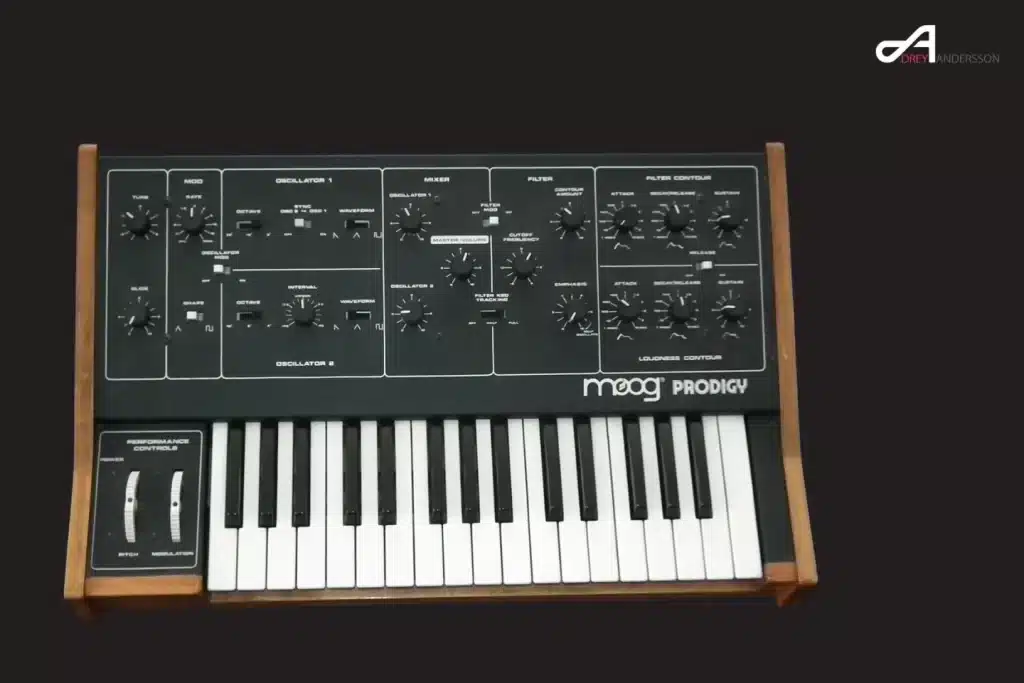
The Moog Prodigy is a monophonic analog synthesizer that Moog Music made from 1979 to 1984, with two oscillators, a 24 dB per octave ladder filter, two contour generators and a 32-note keyboard. Moog sold it as the domestic (US) model 336A and the export model 336BX. Its panel runs left to right from modulation and oscillators through the mixer and filter to the two contours.
This page lists the specs from Moog’s own owner’s manual and service documents, explains how the sound engine is wired, and sorts out the board revisions and CV/gate versions by serial number. It also covers the history, the later Source and Rogue, current emulations and clones, the manuals, and dated used prices.
- Two VCOs, a Moog 24 dB per octave ladder filter, two contour generators, one LFO and oscillator sync, on a 32-note F to C keyboard.
- Moog released it to production in June 1979. A Moog bulletin from July 1981 covers the first 11,000 units.
- Units up to serial 4160 have the first circuit board. Moog offered interface kits for CV, gate and trigger jacks, and Kenton says units from serial 8078 have sockets fitted.
- The owner’s manual lists no noise source, and early units take no external control.
- On 8 November 2026, Reverb estimated a used Prodigy at €907 to €1,930. Martinic released a plugin version in September 2026.
Moog Prodigy specs
Most figures below come from the specifications in the owner’s manual. Metric sizes are my conversions from the printed inches and pounds.
| Feature | Moog Prodigy |
|---|---|
| Made | 1979 to 1984. Released to production in June 1979 |
| Model numbers | 336A domestic (US), 336BX export |
| Voices | Monophonic, single triggering |
| Keyboard | 32 notes, F to C, no velocity or aftertouch |
| Oscillators | 2 VCOs, temperature-regulated (heated chip) |
| Oscillator 1 | Sawtooth, triangle, rectangular (10% pulse). Footages 32′, 16′, 8′ |
| Oscillator 2 | Sawtooth, triangle, square (50%). Footages 16′, 8′, 4′. Interval control over ± a perfect fifth |
| Sync | Switchable, oscillator 2 to oscillator 1 |
| Filter | Moog 24 dB per octave low-pass ladder, emphasis to self-oscillation, keyboard tracking off, half or full |
| Contour generators | 2: filter and loudness. Attack 1 ms to 10 s, decay/release from 1 ms to at least 10 s, sustain 0 to 100%, one release switch |
| Modulation (LFO) | Triangle or square, 0.26 to 31 Hz, to oscillators, filter or both, amount set by the modulation wheel |
| Glide | Linear, under 2 ms to 3 s |
| Wheels | Pitch (over ± a perfect fifth, center detent) and modulation |
| Tune range | ±3 semitones |
| Audio output | 0 dBm |
| External control | None on early units, see the versions section |
| Power | Internal supply. 95 to 135 V, 60 Hz (domestic), 200 to 270 V, 50 Hz (export), under 10 W |
| Size (W x D x H) | 23-1/4 x 14-15/16 x 5-5/8 in (59.1 x 37.9 x 14.3 cm) |
| Weight | 16 lb (7.3 kg) |
| Cabinet | Steel panel, maple side panels and front support, one printed circuit board |
Oscillator 1 and oscillator 2 compared
The two oscillators aren’t identical. Moog’s service manual says oscillator 2 uses a timing capacitor about half the value of oscillator 1’s, so it sits an octave higher, and it adds the interval control and the sync circuit.
| Feature | Oscillator 1 | Oscillator 2 |
|---|---|---|
| Waveforms | Sawtooth, triangle, rectangular | Sawtooth, triangle, square |
| Pulse duty cycle | 10% | 50% |
| Octave footages | 32′, 16′, 8′ | 16′, 8′, 4′ |
| Reference for low F | 44.4 Hz at 32′ | 88.8 Hz at 16′ |
| Extra control | None | Interval, over ± a perfect fifth |
| In sync mode | Master | Reset by oscillator 1, pitch wheel moves only this oscillator |
How the Prodigy’s sound engine works
The Prodigy is a subtractive analog design. Its two oscillators start from bright waveforms such as the sawtooth, the mixer sets their balance, and the filter removes harmonics. The owner’s manual calls the layout logical, with the signal progressing from left to right across the panel.
Oscillators and sync
Both oscillators share one keyboard voltage, the tune control and the pitch wheel. Each sits on a transistor array that a regulating loop holds at 55°C, which Moog’s feature list calls heated chip technology. Moog’s manual gives a scale accuracy of 0.1% and a temperature drift of less than 0.02% per degree Celsius.
With sync on, oscillator 1’s reset pulse also resets oscillator 2, which locks its fundamental to oscillator 1. The pitch wheel then moves only oscillator 2, so it sweeps the sync tone instead of the pitch, and the interval control does the same. With sync off, the pitch wheel moves both oscillators.
Mixer, filter and amplifier
The mixer has a level for each oscillator, and the manual says the mixer and filter were designed to distort when both levels are turned fully to 10. Its sound charts use mistuned oscillators for bell and gong sounds, in a chart called Ring Mod Effects.
The filter is Moog’s patented 24 dB per octave low-pass ladder, built from four one-pole stages. Emphasis feeds energy back at the cutoff frequency, and past 8 on the dial the filter oscillates and produces a sine wave. With keyboard tracking on Full, that sine plays a scale from the keys. Half tracking moves the filter one octave per 2 octaves of keyboard. The cutoff control spans 8 octaves, and the filter contour can sweep the cutoff by up to 8 octaves.
After the filter, a VCA built around an operational transconductance amplifier sets the loudness, and the master volume control comes last before the output jack.
Contours, modulation and triggering
Each of the two contour generators has attack, decay/release and sustain controls. One drives the filter through the contour amount control, and the other drives the VCA. A single release switch sets what happens after you let go of the keys: off, the contour drops to zero quickly, and on, it falls at the decay time. Moog’s service manual calls these four-part envelope generators. Vintage Synth Explorer lists them as A/D/S, and Wikipedia calls them ADR. For the general idea of envelope stages, see ADSR.
The modulation oscillator offers triangle or square waves from 0.26 to 31 Hz. Two switches send it to the oscillators, the filter or both, and the modulation wheel sets the amount, up to 1 octave on the oscillators and 4.5 octaves on the filter with the square wave. The keyboard triggers with single triggering: the contours restart only after all keys are released, so legato playing doesn’t retrigger them. Glide is linear and runs from under 2 ms to 3 seconds.
Details that differ between sources
The owner’s manual names no noise source in its features or specifications, and Wikipedia says the Prodigy has no noise generator. August Worley, a former Moog test engineer, lists a noise source in his 2020 article for the Bob Moog Foundation. The panel in the photo above has no noise control either. For a primer on what a noise source adds, see noise generators.
The CV/gate story also varies. Wikipedia puts the change at serial 4610, while Moog’s own documents split the board at 4160 and the interface kits at 8078. The production total varies too, as the history section explains.
Moog Prodigy versions: 336A, 336BX and CV/gate
The 336A is the domestic model and the 336BX the export model. Moog’s service manual says the export version has a 240 V transformer with extra secondary fuses for IEC safety rules, and the specifications list 200 to 270 V at 50 Hz for export and 95 to 135 V at 60 Hz for domestic units.
The owner’s manual says the keyboard is the only triggering device. Moog’s Factory Service Bulletin No. 1312, dated July 1981, describes interface kits that add jacks for filter and oscillator inputs at 1 V per octave, S-trigger in and out, gate in and out, keyboard control voltage in and out, a sync input and an external audio input. The serial numbers decide which kit applies:
| Serial numbers | What the sources say | Factory interface kit (Bulletin 1312) |
|---|---|---|
| 1001 to 4160 | First production run. The service manual describes this board in its own section. Moog calls these units very difficult to modify | Kit #1, about 3 hours to install |
| Above 4160 to 8077 | Newer circuit board with pads for interfacing | Kit #1, about 3 hours |
| 8078 and above | Kenton says these Mk2 units have KYBD IN/OUT and S-TRIG IN/OUT sockets | Kit #2, about 2 hours |
The Prodigy has no MIDI, according to Kenton, which sells MIDI retrofit kits for both versions. A unit’s rear panel shows which jacks it actually has, and some have been modified since.
Moog Prodigy history
Norlin Corporation owned Moog Music from 1973 to 1983. In the Bob Moog Foundation article, August Worley writes that the Prodigy went into production in June 1979 and was designed by Rich Walborn and Tony Marchese as a low-cost synthesizer similar in design to the Minimoog. Worley started at Moog in May 1980 testing Prodigy boards. He writes that the Prodigy was the first Moog synthesizer to use a microcomputer in its test process, with a Tandy TRS-80 at each testing station. The owner’s manual adds that each unit was burned in for 72 hours before final calibration.
A Buffalo News feature from 13 June 1980 described the Prodigy as Moog’s bid for the mass market, selling for a couple hundred dollars less than competing models. Moog’s artist relations director Rob Konikoff told the paper that Moog expected to make more Prodigies within two years than its 10-year total of Minimoogs. The same article put that total at 13,000 Minimoogs and said the Minimoog sold for about $2,000. Moog’s July 1981 bulletin covers the first 11,000 Prodigys produced. Wikipedia gives 11,000 as the total, but production ran until 1984, and I found no total published by Moog.
The owner’s manual was written by Thomas L. Rhea. It opens with sound charts named Thriller, Synthedrum, Frankenfunk and Elephant And Flea before explaining the controls. Electronics & Music Maker printed a reader’s Prodigy bass patch in April 1984 and noted that the Moog Rogue had since replaced it. A January 1985 issue printed another, a Hammond-style organ sound.
Worley’s article describes two later Moog synthesizers built on the same core. The Source added sequencers, an arpeggiator, sample and hold and 16 preset memories. The Rogue used a reduced control set, added an overdrive feature, and was the first Norlin-era Moog without wood in its case. Its design later became the sound engine of the Taurus II.
The Horniman Museum says the synth inspired the naming of the band The Prodigy, and that it appears in music by Blur, Massive Attack and Nine Inch Nails. Vintage Synth Explorer lists users including 808 State, Depeche Mode, Fatboy Slim and Howard Jones. I haven’t checked those recordings individually.
Other monophonic synths on this site include the Sequential Circuits Pro-One and the Behringer Pro-1. For the wider context, see my article on analog and digital synthesizers.
Moog Prodigy emulations and clones
None of the sources I read mention a hardware reissue by Moog Music. The Prodigy has a software emulation and a Eurorack clone from other companies, plus aftermarket kits:
| Product | Type | First shown | What it adds to the original | Source |
|---|---|---|---|---|
| Martinic Prodigy | Plugin: VST, VST3, AU, AAX, CLAP | September 2026 | Sub oscillator, noise, Multidrive, spring reverb, 8-voice polyphony, 6-voice unison, 16-step sequencer, MPE | Martinic, Rekkerd |
| Ensure Sound Prodigy ER-16 | Eurorack module, 42 HP | October 2016 | No keyboard. Noise generator, external audio input, sync input, waveform outputs, dual CV inputs | Gearnews, ModularGrid |
| Kenton MIDI retrofit | Internal kit for the original | Not dated | MIDI In and Thru | Kenton |
Martinic’s Prodigy was announced on 3 September 2026 at an introductory €33 until 16 September 2026, with a regular price of €66, according to Rekkerd. Martinic describes it as an Advanced Circuitry Emulation (ACE) model of the 1979 circuit. It is a plugin only, with no standalone version, according to Sound On Sound’s review, published online on 17 September 2026 for its October 2026 issue. That review also notes extra waveforms on both oscillators and a drive stage placed after the filter. Martinic’s product page doesn’t say whether Moog Music licensed it.
The Ensure Sound Prodigy ER-16 is a 42 HP Eurorack synth voice from Dimitry Shentyapin in Kraków, Poland. Gearnews reported in March 2017 that it sold through eBay for 2650 Polish zloty, about £540 or $670 at the time. ModularGrid listed it as currently available on 8 November 2026.
Moog Prodigy demo videos
The first video is Howard Jones on his own two Prodigys. The second is a sound demo that was recorded for an eBay sale.
Moog Prodigy manual and service documents
These copies of Moog’s Prodigy documents are online:
- Owner’s manual, a 44-page scan on ManualsLib, with sound charts, the Synthesizing By Ear experiments, an explanation of each section, features and specifications.
- Service manual on Archive.org, with circuit descriptions for the boards up to serial 4160 and above it.
- Technical Service Information for units above serial 4160, copyright 1980, with schematics and the alignment procedure.
- Factory Service Bulletin No. 1312 from July 1981, with production changes and the interface kit instructions.
The ManualsLib scan has no text layer, so I read its pages as images. The Archive.org files have OCR text that can be searched, with some scanning errors.
Moog Prodigy price and availability
Moog Music no longer makes the Prodigy, so instruments now sell used. On 8 November 2026, viewed from Berlin, Reverb’s Prodigy page estimated the used value at €907 to €1,930, based on 47 orders in good to mint condition. Its transaction table showed these seven sales:
Seven listings on the same page asked €1,200 to €2,806.76. The highest was a 336BX with an E.M.I. plate, and one listing’s title mentions MIDI and CV/gate. A US Google Shopping block that day showed four pre-owned units at $1,200 to $1,399.99. These are asks, not sales, and they change quickly. For a period comparison, the 1980 Buffalo News feature placed the new Prodigy a couple hundred dollars below its competitors, but I haven’t found a dated list price from Moog.
Frequently asked questions
When was the Moog Prodigy made?
Moog Music released the Prodigy to production in June 1979, according to a former Moog engineer writing for the Bob Moog Foundation. The Horniman Museum and Vintage Synth Explorer both give 1979 to 1984 as its production years. An April 1984 magazine article said the Moog Rogue had replaced it.
How many Moog Prodigy synths were made?
Moog’s Factory Service Bulletin 1312, dated July 1981, covers the first 11,000 Prodigys produced. Wikipedia gives 11,000 as the total, but production continued until 1984, so the final number may be higher. I found no total published by Moog itself.
Does the Moog Prodigy have CV and gate inputs?
Early units don’t, and the owner’s manual names the keyboard as the only triggering device. Moog’s 1981 bulletin describes kits that add CV, gate, S-trigger, sync and audio inputs. Kenton says units from serial 8078 have KYBD IN/OUT and S-TRIG IN/OUT sockets, and that no factory version has MIDI.
What filter does the Moog Prodigy use?
It uses Moog’s patented 24 dB per octave low-pass ladder filter, a four-pole design. Emphasis feeds energy back at the cutoff and makes the filter self-oscillate as a sine wave past 8 on the dial. Keyboard tracking has off, half and full positions, and the cutoff control spans 8 octaves.
Does the Moog Prodigy have a noise generator?
Moog’s owner’s manual lists no noise source among the Prodigy’s features or specifications, and Wikipedia says it has none. A 2020 Bob Moog Foundation article by former Moog engineer August Worley does list a noise source. The Martinic plugin and the Ensure Sound ER-16 clone both add one.
What is the difference between the Moog Prodigy 336A and 336BX?
Moog’s service manual calls the 336A the domestic model and the 336BX the export model. The export unit has a 240 V transformer with extra secondary fuses for IEC safety rules and runs on 200 to 270 V at 50 Hz. The domestic unit runs on 95 to 135 V at 60 Hz.
Is there a Moog Prodigy VST or reissue?
Martinic released a Prodigy plugin in September 2026, in VST, VST3, AU, AAX and CLAP formats, at an introductory €33. The Ensure Sound ER-16 is a 42 HP Eurorack clone first shown in 2016, and ModularGrid listed it as available on 8 November 2026. None of the sources I read mention a hardware reissue by Moog Music.
Was The Prodigy band named after the Moog Prodigy?
The Horniman Museum says the Moog Prodigy inspired the naming of the band The Prodigy, and Wikipedia says the same. Vintage Synth Explorer lists Prodigy among the synth’s users, along with 808 State, Depeche Mode and Howard Jones, who posted a video about his two Prodigys in April 2025.
How much is a used Moog Prodigy worth?
On 8 November 2026, viewed from Berlin, Reverb estimated €907 to €1,930 from 47 orders in good to mint condition. Its newest listed sale was €1,549 in October 2026, and seven listings asked €1,200 to €2,806.76. Reverb says its estimate excludes shipping and tax, and all of these figures change often.
Back to Music Production Terms Index Page