What is a supersaw?
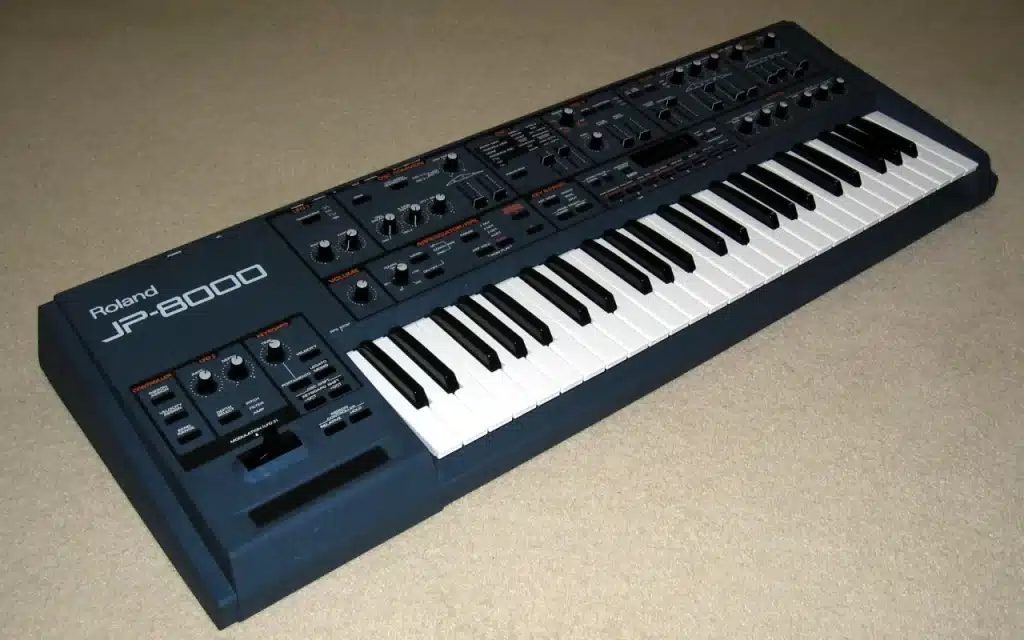
A supersaw is a synth sound built from seven sawtooth waves, each tuned slightly apart and played as one. Roland introduced it on the JP-8000, a synth its own history says was “released in 1996” (Roland, 2022). Roland’s supplemental notes describe it as “seven sawtooth oscillators using only one voice of polyphony” (Roland JP-8000 Supplemental Notes, 1997). The result is a wide, shimmering wall of sound that, in Attack Magazine’s words, “came to define an entire era of trance music” (Attack Magazine, 2026).
Technically, it’s just a very particular oscillator mode. A plain saw already contains every harmonic, which makes it natural raw material for subtractive synthesis. Stack seven of them, detune them against each other, and the static buzz turns into constant motion. Today the word is often used loosely for any detuned saw stack, from Roland hardware to a 16-voice unison patch in a plugin.
- A supersaw stacks seven detuned sawtooth waves. Roland’s JP-8000 introduced it in 1996.
- Two controls run it: Detune spreads the pitches, Mix balances the center saw against the six side saws.
- Detuned saws beat against each other. In our test, the low end of a 7-voice stack swung by a median 19.2 dB.
- High-pass the stack and keep the sub bass separate.
How does a supersaw work?
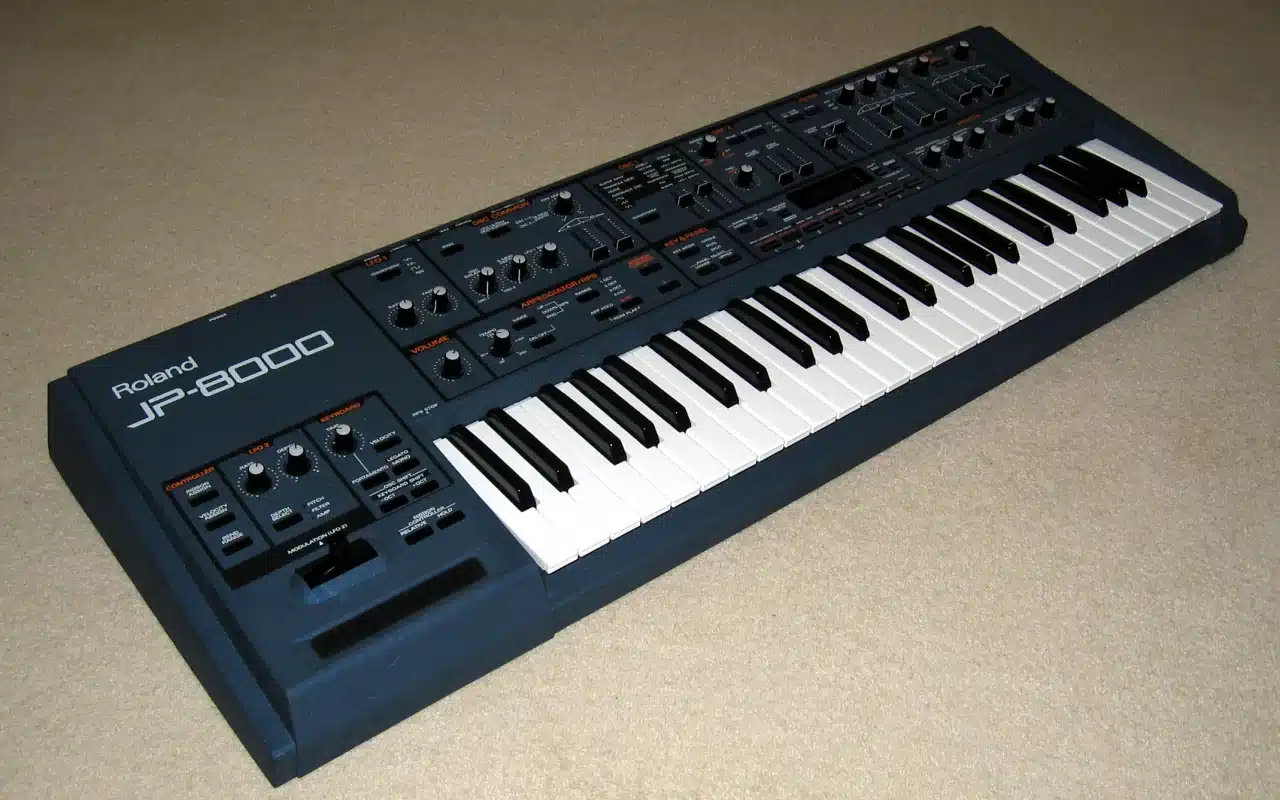
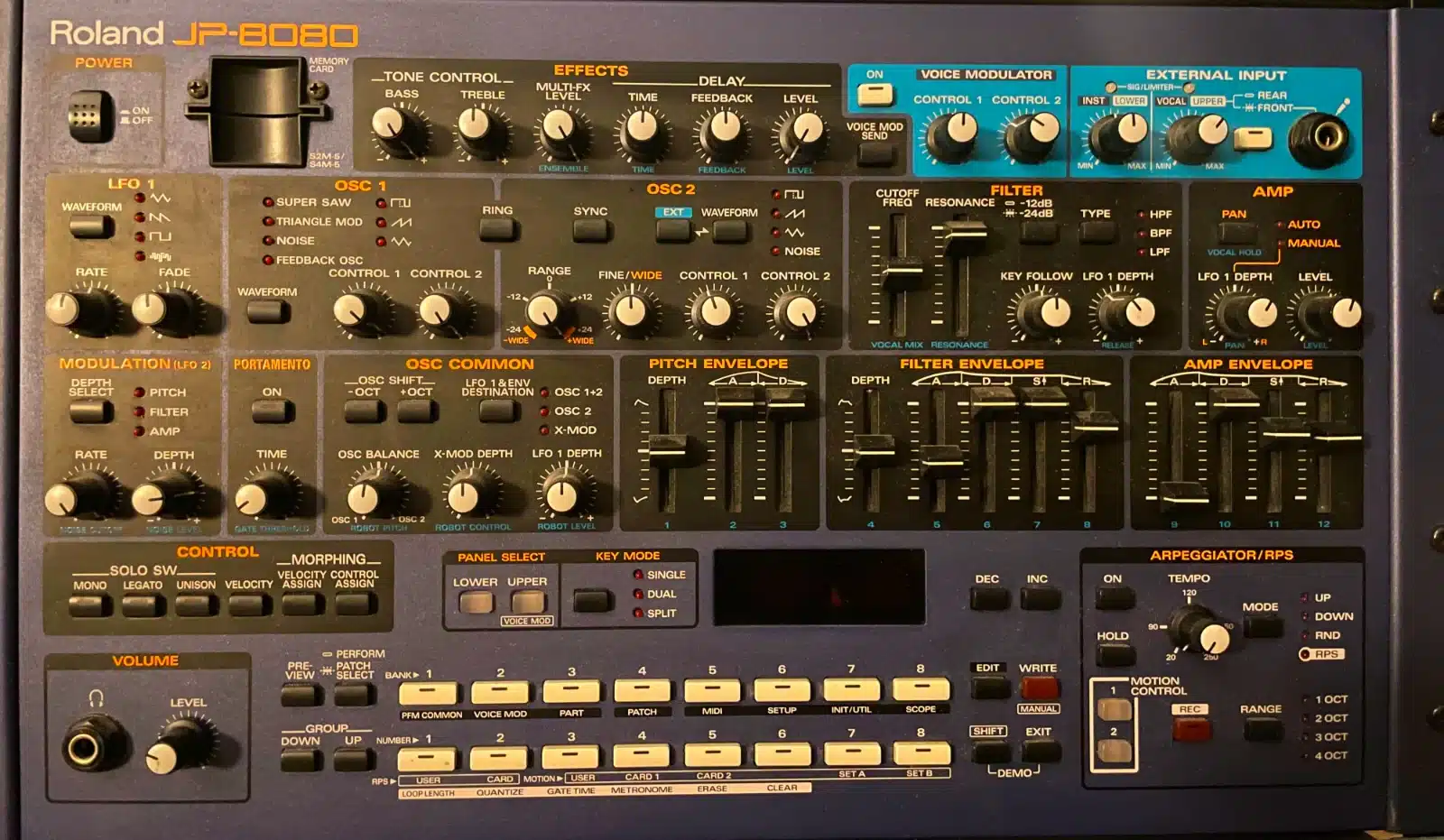
A supersaw works by detuning seven saws against each other and fading the outer six in against the center one. On the JP-8000 that takes just two controls: Control 1 sets the detune and Control 2 sets the mix. Roland’s manual says that as you raise the mix, “the sound will become thicker as if several sounds were being played simultaneously” (JP-8000 Owner’s Manual, 1996).
What Szabo measured
In 2010, Adam Szabo analyzed recordings of the JP-8000’s Super Saw for his bachelor’s thesis at KTH Royal Institute of Technology in Stockholm and rebuilt it in code (Szabo, How to Emulate the Super Saw, 2010). His thesis is a detailed public measurement of the sound. He found:
- The detune curve isn’t linear. Szabo writes that it “is not linear”. It barely moves through the lower half of the knob, then rises sharply past about 90%.
- The mix is a crossfade with a twist. The center saw falls in a straight line while the side saws rise along a curve.
- A high-pass filter tracks the pitch. It follows the first harmonic, so it trims rumble below the note you play.
- Every note starts at a random phase. A new phase value is assigned at each note trigger, so no two notes begin quite the same way.
- Aliasing is part of the sound. Szabo credits the digital noise it adds with the sound’s “airiness”.
His table of oscillator offsets shows how wide full detune really is. Converted to cents (our arithmetic, not stated in the thesis), the lowest saw sits about 2 semitones below the center and the highest about 1.8 semitones above it. The gaps between neighbors aren’t even either: 34, 78 and 89 cents on the flat side, 34, 70 and 72 cents on the sharp side.
The 2025 chip decode
Fifteen years later, the chip itself was decoded. At the 39th Chaos Communication Congress in December 2025, the researcher giulioz presented a reverse engineering of the JP-8000’s custom DSP chips. The talk describes “a mixture of automated silicon reverse engineering, probing the chip with an Arduino, statistical analysis of the opcodes and fuzzing” (media.ccc.de, 39C3). The verdict, as gearnews reported it: seven saws, a high-pass filter and a sample rate doubled to 88.2 kHz (gearnews, January 2026).
Why does a supersaw sound so big?
A supersaw sounds big because seven detuned saws form 21 pairs, and each pair beats. Two tones a few hertz apart pulse at a rate “equal to the absolute value of the difference in frequency” (HyperPhysics, Georgia State University). Gordon Reid covers the same beating between detuned oscillators in his Synth Secrets column (Sound On Sound, 2003).
Here the JP-8000’s uneven offsets matter. With Szabo’s values, the 21 pairs spread across roughly 14 distinct beat rates, though a few mirror-image pairs land within 1 to 3% of each other. In a basic unison patch with evenly spaced voices, they collapse into six groups: the six neighboring pairs all beat at nearly the same rate, the five two-apart pairs at another, and so on. That’s our arithmetic, and it’s one reason a plain unison stack can sound more regular than the original.
A saw contains every harmonic, and detuning in cents shifts each harmonic by a proportional amount. So the beating speeds up as you climb the harmonic series. The fundamental might drift slowly while the upper harmonics shimmer dozens of times a second. We think that split, slow swell underneath and fast fizz on top, is a large part of why it reads as “huge”.
| Harmonic | Beat rate at A2 (110 Hz) | Beat rate at A4 (440 Hz) |
|---|---|---|
| 1st (fundamental) | 3.18 Hz | 12.71 Hz |
| 2nd | 6.35 Hz | 25.42 Hz |
| 4th | 12.71 Hz | 50.83 Hz |
| 8th | 25.42 Hz | 101.67 Hz |
| 16th | 50.83 Hz | 203.33 Hz |
The same arithmetic explains why a supersaw changes character up and down the keyboard. Play the same patch two octaves higher and every beat rate quadruples. That’s why a detune setting that sounds lush on a chord in the middle register can turn sour and seasick on a high lead. It’s worth trimming the detune for leads and opening it up for pads.
What we measured: the supersaw’s unstable low end
In our test, the low end of a 7-voice saw stack swung by a median 19.2 dB between its loudest and quietest moments, while a single saw held steady. For this entry we rendered band-limited saw stacks at A2 (110 Hz), spread evenly across ±25 cents with random start phases, and measured the level below 160 Hz in 50 ms windows over 12 runs. The test uses fixed random seeds, so the numbers are reproducible.
That’s the catch with any wide, unfiltered saw stack. Note that this is an even-spread unison stack with no tracking filter, not the JP-8000’s exact recipe. The detuned fundamentals drift in and out of phase cancellation, so the bass of the stack pumps on its own. Adding voices doesn’t fix it. Nine and sixteen voices swung even further.
We also tested phase retrigger, the option that restarts every saw at the same point on each note. With retrigger on, the first 20 ms of a 7-voice note peaked 1.5 dB above the steady-state peak (measured 1 to 3 seconds in), and every note hit identically. With random phases, the onset sat a median 4.4 dB below the steady-state peak. It’s a good argument for the JP-8000’s random phases, and a good reason to leave retrigger off for pads.
The fix: high-pass the supersaw with an EQ somewhere around its lowest note, the way the original’s tracking filter does, and let a separate mono sine or sub patch carry the bass. Then check the mix in mono. Mike Senior warns that wide pads can “lose definition, or even disappear completely, in mono” (Sound On Sound, 2010).
A short history of the supersaw
Sound On Sound’s review was lukewarm about it. Reviewing the JP-8000 in March 1997, Sound On Sound’s Paul Ward wrote: “Of all the waveforms on offer I was most disappointed with this one” (Sound On Sound). Trance producers, by Roland’s account, took to it anyway. Arturia, which now sells a JP-8000 emulation, says the sound has since been “infused into genres like hardstyle, eurodance, and hyperpop” (Arturia).
Roland’s own history of early trance lists among the style’s hallmarks “longer major chord progressions, dramatic breakdowns, and the sound of the Super Saw” (Roland, 2022). The same guide names Ferry Corsten as “one of the first producers to utilize the supersaw”, says BT used the JP-8000 on “Godspeed”, and says the JP-8080 “featured heavily” on Darude’s “Sandstorm”. Those are Roland’s claims about its own instrument, so read them that way.
Access built its own version in hardware. The Virus TI’s HyperSaw takes a density setting from 1 to 9, “the number of sawtooth waves used” (Access Virus TI Snow Parameter Reference). If you miss that sound, our piece on the Virus TI emulation OsTIrus covers running the original DSP code on a computer.
Which synths have a supersaw?
Roland kept the Super Saw alive for decades, from the JP-8000 to the JD-XA, whose features page calls it “Roland’s famous Supersaw waveform” (Roland). In software, the waveform became a unison setting. Serum and Vital both stack up to 16 voices per oscillator, enough to build a supersaw from any saw.
| Instrument | Type | How it does the supersaw |
|---|---|---|
| Roland JP-8000 / JP-8080 | Hardware | The original: 7 saws, Detune and Mix |
| Roland SH-201, GAIA SH-01 | Hardware | Super Saw in the oscillator waveform list |
| Roland JD-Xi | Hardware | Super Saw in the digital section (not the analog part) |
| Roland JD-XA | Hardware | Digital Supersaw, plus an 8-oscillator analog version |
| Access Virus TI | Hardware | HyperSaw, 1 to 9 saws per oscillator |
| Roland ZENOLOGY | Software | Dedicated Supersaw oscillator type |
| Arturia Jup-8000 V | Software | An emulation of the JP-8000 itself |
| Xfer Serum, Vital | Software | Unison up to 16 voices per oscillator |
| Reveal Sound Spire | Software | Unison up to 9 voices per oscillator |
| LennarDigital Sylenth1 | Software | Unison up to 8 voices per oscillator |
Is a unison saw really a supersaw? Close, but not identical. A basic unison setup spreads its voices evenly and lets you pick the count, while the JP-8000 used fixed, uneven offsets and a pitch-tracking high-pass filter. Some plugins offer other spread curves, so check what yours does before assuming it matches the original.
How to make a supersaw in any synth
You don’t need a dedicated supersaw synth. Seven saw voices in unison will get you most of the way, the same count Roland chose in 1996. Spire’s manual even gives a recipe: set the density fully right with seven voices (Reveal Sound Spire manual). The rest is about controlling the detune and protecting the low end.
- Pick a saw and set unison to 7 voices. More voices don’t steady the low end, as the measurement above shows.
- Detune with care. Start low and raise it until the sound widens. Remember that the original’s curve barely moves through the lower half of its range.
- Balance the center voice. If your synth offers a blend or mix control, keep some center saw so the pitch stays clear. That’s the JP-8000’s Mix knob.
- Randomize the start phase for pads and chords, either by turning phase retrigger off or with a random-phase setting, so notes don’t all start identically.
- Spread the voices in stereo, then check the patch in mono before you commit.
- High-pass the stack near its lowest note and put the bass on a separate mono sub.
- Shape the volume with an ADSR envelope: a slow attack for pads, a fast attack and medium release for plucks and leads.
Want a different flavor of width? Pulse width modulation thickens a single oscillator without stacking voices, and wavetable synths such as Serum and Vital let you run unison on any wavetable frame, not just a saw. Both are worth trying when a supersaw sounds too familiar. Most of these synths run as a VST, and the virtual analog idea behind the JP-8000 is explained in our analog vs digital synthesizers guide.
Frequently asked questions
What is a supersaw in simple terms?
A supersaw is a thick synth sound made by playing seven sawtooth waves together, each tuned slightly differently. The small pitch differences make the waves drift in and out of phase, which creates a wide, shimmering tone. Roland introduced it on the JP-8000 synthesizer in 1996, and it became a signature sound of late-1990s trance.
Which synth invented the supersaw?
The Roland JP-8000 introduced the Super Saw in 1996, and Sound On Sound reviewed it in March 1997. Roland developed the waveform specifically for that 8-voice analog modeling synth. The JP-8080 rack version followed in 1998, and later Roland synths such as the SH-201, GAIA SH-01, JD-Xi and JD-XA kept a Super Saw waveform.
How many saw waves are in a supersaw?
The original Roland Super Saw uses seven sawtooth waves on a single voice of polyphony. Modern plugins let you choose: Serum and Vital stack up to 16 unison voices per oscillator, Spire up to 9 and Sylenth1 up to 8. The Access Virus TI’s HyperSaw uses between 1 and 9 saws per oscillator.
What is the difference between a supersaw and unison?
Unison is a general feature that stacks copies of any waveform and detunes them, usually with evenly spaced voices. A supersaw is a specific saw stack. The JP-8000 version uses seven saws at fixed, uneven offsets, a non-linear detune curve and a pitch-tracking high-pass filter, which is why emulations sound different from a plain unison patch.
Why does my supersaw lose bass or sound thin in mono?
Detuned saws drift in and out of phase, so their fundamentals keep canceling and reinforcing each other. In our test, the low end of a 7-voice stack swung by a median 19.2 dB. Voices spread in stereo can also cancel when summed to mono. High-pass the supersaw, add a separate mono sub, and check wide patches in mono.
What is the difference between a supersaw and a HyperSaw?
Super Saw is Roland’s name for the seven-saw oscillator on the JP-8000. HyperSaw is the Access Virus TI’s version, where a density setting chooses from 1 to 9 sawtooth waves per oscillator, with a spread control from 0 to 127. Both stack detuned saws; they differ in voice count, controls and character.
Back to Music Production Terms Index Page
Back to Music Production Terms Index Page