Polyrhythm meaning
A polyrhythm is two or more rhythms played at the same time that divide the same span of time into different numbers of equal parts. In a 3:2 polyrhythm, one part plays three evenly spaced hits while another plays two in the same bar, and both start together on the downbeat. Wikipedia defines it as “the simultaneous use of two or more rhythms that are not readily perceived as deriving from one another” (Polyrhythm).
In short
- A polyrhythm puts different even divisions of the same span on top of each other: 3 against 2, 4 against 3, 5 against 4.
- A polymeter keeps the step size the same and changes the loop length instead, so the parts drift apart and meet again later.
- On a step sequencer, polymeter is the easy one: give each track its own length. A 16-step and a 15-step track take 240 steps to line up again.
- Euclidean rhythms spread k hits as evenly as possible over n steps. Godfried Toussaint showed in 2005 that this simple rule produces many traditional rhythms, including the Cuban tresillo, E(3,8).
- I ran Bjorklund’s algorithm on all 27 patterns Toussaint prints and got every one back exactly.
You say a polyrhythm as “3 against 2” or write it as a ratio, 3:2. Both numbers are counts of evenly spaced hits in the same cycle. A closely related term is cross-rhythm, and the 3:2 case also has an older name. Wikipedia writes: “Another straightforward example of a cross-rhythm is 3 evenly spaced notes against 2 (3:2), also known as a hemiola”. Its hemiola article puts it as “three beats of equal value in the time normally occupied by two beats”.
For a producer, polyrhythm is less a theory term than a programming problem. A DAW grid, a drum machine and a groovebox all start from one grid by default. A polyrhythm needs two grids at once, so the question is always how to get the second one.
How polyrhythm ratios work: 3:2, 4:3 and 5:4
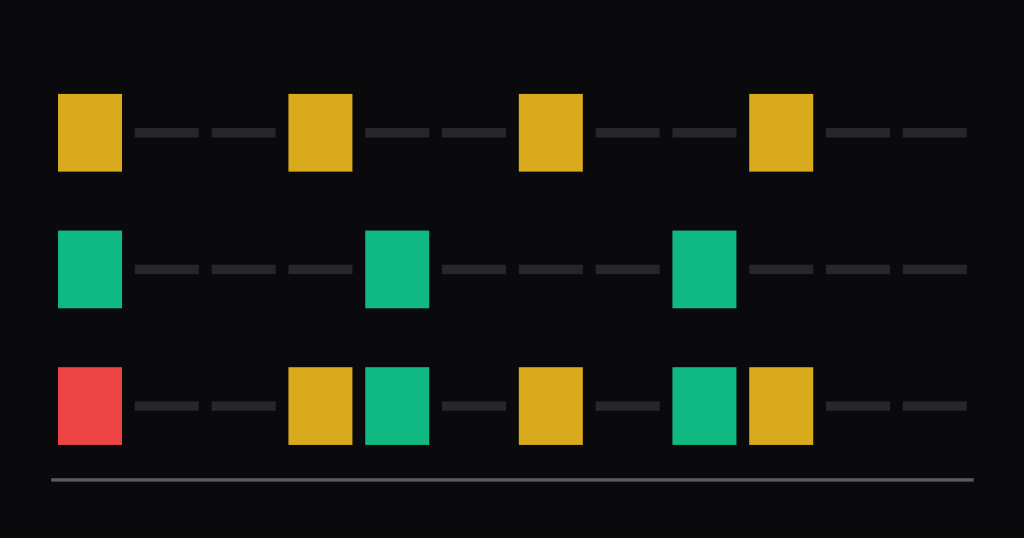
To draw any polyrhythm on one grid, use the least common multiple of the two numbers as the number of steps. 3 and 2 share a grid of 6 steps: the three-part hits on steps 1, 3 and 5, the two-part on steps 1 and 4. For 4:3 you need 12 steps, and for 5:4 you need 20. That’s why a polyrhythm feels hard to program on a 16-step sequencer: 16 divides evenly by 2, 4 and 8, but not by 3, 5 or 7.
When the two numbers share no common factor (3 and 2, 4 and 3, 5 and 4), the parts only land together once per cycle, on the downbeat. Everything else falls between the other part’s hits. Add both parts together and you get a third rhythm, the composite, which is what a listener actually hears. For 3:2 it has 4 hits with gaps of 2, 1, 1 and 2 steps. That composite is often the easiest way to learn a polyrhythm by ear or to program it on one track.
I computed the grid, the composite and the smallest gap between two hits for seven common ratios, with one cycle set to one 4/4 bar at 120 BPM (2,000 ms). The smallest gap matters in a mix: the closer two hits get, the harder they are to tell apart in a busy arrangement.
| Ratio | Grid (steps) | Shared hits | Hits you hear | Gaps in steps | Smallest gap at 120 BPM |
|---|---|---|---|---|---|
| 3:2 | 6 | 1 | 4 | 2-1-1-2 | 333.33 ms |
| 4:3 | 12 | 1 | 6 | 3-1-2-2-1-3 | 166.67 ms |
| 5:4 | 20 | 1 | 8 | 4-1-3-2-2-3-1-4 | 100.00 ms |
| 5:3 | 15 | 1 | 7 | 3-2-1-3-1-2-3 | 133.33 ms |
| 7:4 | 28 | 1 | 10 | 4-3-1-4-2-2-4-1-3-4 | 71.43 ms |
| 6:4 | 12 | 2 | 8 | 2-1-1-2-2-1-1-2 | 166.67 ms |
| 9:8 | 72 | 1 | 16 | 8-1-7-2-6-3-5-4-4-5-3-6-2-7-1-8 | 27.78 ms |
Two results stand out. First, 6:4 is not a new polyrhythm. Its numbers share a factor of 2, so it’s just 3:2 played twice per bar, with 2 shared hits instead of 1. Reduce the ratio first. Second, the smallest gap shrinks fast as the numbers grow. At 120 BPM a 9:8 polyrhythm puts two hits 27.78 ms apart, while 3:2 never gets closer than 333.33 ms.
Polyrhythm vs polymeter
A polyrhythm keeps the cycle fixed and changes the number of hits in it. A polymeter keeps the hit spacing (the step or beat) fixed and changes the length of the cycle. Wikipedia’s polymeter article puts the contrast in two lines: “With polymetre, the bar sizes differ, but the beat remains constant” and “With polyrhythm, the number of beats varies within a fixed bar length”.
In a polymeter, the parts drift against each other and line up again after a while. As the same article says, “Since the beat is the same, the various metres eventually agree.” In a polyrhythm, they line up every cycle. You can hear the difference: a polyrhythm repeats every bar, while a polymeter can take many bars before the same combination comes back.
Changes: how many even hits fit in it
Meet: every cycle
Example: 3 against 2: three hits and two hits per bar
Changes: the loop length
Meet: after the least common multiple of the lengths
Example: A 16-step track against a 15-step track
This is why polymeter is the native language of step sequencers. Set one track to 16 steps and another to 15, and the 15-step part moves one step earlier against the 16-step part every bar. Nothing about the tempo or the step size changes. The two loops simply restart at different times.
How long does it take until everything lines up again? It’s the least common multiple of the track lengths. I worked it out for common pairs on a 16th-note sequencer at 120 BPM, where one step is 125 ms:
| Track lengths | Steps until aligned | Bars of 16 steps | Time at 120 BPM |
|---|---|---|---|
| 16 + 12 steps | 48 | 3 | 6 s |
| 16 + 15 steps | 240 | 15 | 30 s |
| 16 + 13 steps | 208 | 13 | 26 s |
| 16 + 7 steps | 112 | 7 | 14 s |
| 16 + 5 steps | 80 | 5 | 10 s |
| 16 + 3 steps | 48 | 3 | 6 s |
| 16 + 15 + 13 steps | 3,120 | 195 | 6.5 min |
| 16 + 15 + 13 + 11 steps | 34,320 | 2,145 | 71.5 min |
A 16-step and a 12-step track meet after only 3 bars, because they share a factor of 4. A 16-step and a 15-step track need 15 bars. Add a 13-step track and the full pattern repeats only every 3,120 steps, which is 195 bars or 6.5 minutes. Add an 11-step track and it’s 34,320 steps, more than 71 minutes. Lengths that share no common factor, like 16, 15, 13 and 11, are what make a short set of loops sound like a long, changing part.
How to program a polyrhythm in a DAW, step sequencer or groovebox
There are three practical ways to get a second grid. Which one you use depends on whether you want a true polyrhythm (fixed cycle) or a polymeter (fixed step).
In a DAW: change the grid or the clip length
For a true polyrhythm in a DAW piano roll, switch the grid for one part to triplets for 3 against a straight 2 or 4. For 5 or 7 against 4, most DAW grids have no matching setting, so turn snap off and place the notes by position, using the least-common-multiple grid from the table above as your guide. For a polymeter, use clips of different lengths that loop on their own. In Ableton Live, each clip has its own loop, and the manual explains that you set it “by entering the desired values into the Loop Position and Length fields” (Live 12 manual, Clip View).
A 3-beat clip next to a 4-beat clip is a 3-over-4 polymeter. To print it, record the result into the arrangement for as many bars as the cycle needs. Each clip is just a loop with a different length.
On a step sequencer or groovebox: per-track length
Many hardware sequencers let each track run its own length. Elektron lists “Individual pattern length per track” and “Individual time scale multiplier per track” on its Digitakt II page, and the Polyend Play manual says “Each track can have an independent length”.
Track length gives you polymeter. The time scale multiplier is the polyrhythm tool: one track running at a different speed fills the same bar with a different number of steps. Which ratios you can reach depends on the multipliers your box offers. In a DAWless setup, where one box is the master clock, per-track length is usually the fastest route.
In a modular system: clock dividers
In Eurorack, a clock divider turns one master clock into slower related clocks. Doepfer describes its A-160 as a module that “is a frequency divider for clock/trigger/gate signals”, with outputs “from half the clock frequency down to 1/64” (Doepfer A-160).
Divisions of one master clock stay locked together, so the ratio between two outputs is the polyrhythm: dividing by 2 and by 3 gives 3 against 2, while dividing by 2 and by 4 only gives a straight double time. The A-160’s outputs are the halving kind, so for odd ratios pick a divider that offers the divisions you need. Send one clock to sequencers with different step counts and you get a polymeter instead. An arpeggiator with a 3-note pattern over a 4-step bass is the same kind of polymeter: 3 steps against 4 over one clock.
Euclidean rhythms and Euclidean sequencers
A Euclidean rhythm spreads k hits as evenly as possible across n steps, written E(k,n). The idea comes from Godfried Toussaint’s 2005 paper “The Euclidean Algorithm Generates Traditional Musical Rhythms” (Proceedings of the Bridges conference, Banff, pages 47 to 56, as listed in Wikipedia’s Euclidean rhythm article). He showed that these rhythms “have the property that their onset patterns are distributed as evenly as possible”, and that many of them are rhythms musicians already play.
The method didn’t start in music. Toussaint borrows it from Bjorklund’s work on the timing systems of “spallation neutron source (SNS) accelerators used in” nuclear physics, where the task was to “distribute the pulses as evenly as possible among these intervals”. Bjorklund’s algorithm has the same structure as Euclid’s algorithm for the greatest common divisor, hence the name.
Toussaint calls E(3,8) = x..x..x. (x is a hit, a dot is a rest) “one of the most famous on the” planet. He writes that “In Cuba it goes by the name of the tresillo” and gives the bass rhythm of Elvis Presley’s Hound Dog as an example. E(5,8) = x.xx.xx. is the cinquillo, which he identifies as “the hand-clapping pattern” in the same song. And when E(2,5) is started on its second hit, he notes that “it is the metric pattern of Dave Brubeck’s Take Five”.
I wrote a short Python version of Bjorklund’s algorithm, following the step-by-step description in the paper, and ran it on all 27 E(k,n) patterns Toussaint prints, including his worked example E(5,13) and the trivial one-hit patterns. It reproduced 27 of 27 exactly, in the same rotation as the paper.
My first attempt got only 23 right in the paper’s rotation: it stopped too early when a pattern has more than one hit but only one rest (E(2,3), E(3,4), E(5,6), E(7,8)), and returned rotations such as xx. instead of x.x. The paper’s printed E(2,3) = x.x shows that the first pairing step must always run. One detail for anyone checking: the paper prints E(5,16) with 17 symbols, but its interval vector (3,3,3,3,4) adds up to 16, so the 16-step form x..x..x..x..x… is the right one.
| E(k,n) | Pattern (x = hit) | Example Toussaint gives | My Bjorklund output matches |
|---|---|---|---|
| E(1,2) | x. |
trivial, one hit | Yes |
| E(1,3) | x.. |
trivial, one hit | Yes |
| E(1,4) | x... |
trivial, one hit | Yes |
| E(2,3) | x.x |
Afro-Cuban conga pattern | Yes |
| E(2,5) | x.x.. |
Persian Khafif-e-ramal | Yes |
| E(3,4) | x.xx |
Cumbia (Colombia) | Yes |
| E(3,5) | x.x.x |
Persian / Rumanian (rotated) | Yes |
| E(3,7) | x.x.x.. |
Bulgarian Ruchenitza; Pink Floyd’s Money | Yes |
| E(3,8) | x..x..x. |
Cuban tresillo | Yes |
| E(4,7) | x.x.x.x |
Bulgarian Ruchenitza | Yes |
| E(4,12) | x..x..x..x.. |
Fandango clapping (Flamenco, 12/8; dots = soft claps) | Yes |
| E(4,9) | x.x.x.x.. |
Aksak (Turkey) | Yes |
| E(4,11) | x..x..x..x. |
Frank Zappa, Outside Now | Yes |
| E(5,6) | x.xxxx |
York-Samai, Arab (rotated) | Yes |
| E(5,7) | x.xx.xx |
Nawakhat (Arab) | Yes |
| E(5,8) | x.xx.xx. |
Cuban cinquillo | Yes |
| E(5,9) | x.x.x.x.x |
Agsag-Samai (Arab) | Yes |
| E(5,11) | x.x.x.x.x.. |
Moussorgsky, Pictures at an Exhibition | Yes |
| E(5,12) | x..x.x..x.x. |
Venda clapping pattern (South Africa) | Yes |
| E(5,13) | x..x.x..x.x.. |
worked example | Yes |
| E(5,16) | x..x..x..x..x... |
Bossa-Nova necklace (Brazil) | Yes |
| E(7,8) | x.xxxxxx |
Bendir rhythm (Tuareg, Libya) | Yes |
| E(7,12) | x.xx.x.xx.x. |
West African bell pattern | Yes |
| E(7,16) | x..x.x.x..x.x.x. |
Samba necklace (Brazil) | Yes |
| E(9,16) | x.xx.x.x.xx.x.x. |
Central African Republic necklace | Yes |
| E(11,24) | x..x.x.x.x.x..x.x.x.x.x. |
Aka Pygmies (Central Africa) | Yes |
| E(13,24) | x.xx.x.x.x.x.xx.x.x.x.x. |
Aka Pygmies (Central Africa) | Yes |
Two of the table’s rhythms are worth singling out. E(7,12) = x.xx.x.xx.x. is “a common West African bell pattern” that “is used in the Mpre” rhythm of the Ashanti people of Ghana. E(4,12) is the “Fandango clapping pattern” of Flamenco, where Toussaint reads the dots as soft claps rather than rests.
Euclidean rhythms and polyrhythms meet in practice. E(3,8), or its rotation x..x.x.., is the closest an 8-step grid gets to 3 against 2: on one track against straight eighth notes, it gives an uneven 3-in-8 feel, and running two Euclidean patterns of different lengths gives you a polymeter. A Euclidean sequencer only needs two numbers per track (hits and steps), plus usually a rotation control to shift the start point.
You don’t need special hardware. Ableton’s Live 12 manual says “Euclidean is a Max for Live Generator” that makes “Euclidean rhythms for up to four voices at a time” (MIDI Tools). Torso Electronics lists “Euclidean rhythms” among the generative tools of its T-1 sequencer, with the line “Create dynamic rhythmic patterns with built-in movement”. On any 16-step sequencer you can also enter a pattern from the table above by hand.
Famous polyrhythm and polymeter examples
- Chopin, Fantaisie-Impromptu. A classic 4 against 3: “the right hand plays sixteenth notes against the left hand playing triplets” (Wikipedia).
- King Crimson, Discipline. “King Crimson used polyrhythms extensively in their 1981 album Discipline” (Wikipedia).
- Aphex Twin. The same article states that “Aphex Twin makes extensive use of polyrhythms in his electronic compositions”.
- Meshuggah. A well-known polymeter band: “Polymetres are a defining characteristic of the music of Meshuggah” (Wikipedia), and its band article lists “polyrhythms, polymetered riff cycles, rhythmic syncopation” among its trademarks (Wikipedia).
The list shows how wide the term runs, from a 19th-century piano piece to progressive rock, metal riffs and electronic music. What they share is the mechanism from the sections above: two even divisions of the same span, or two loops of different lengths over one pulse.
Frequently asked questions
What is a polyrhythm in simple terms?
A polyrhythm is two rhythms at once that split the same span of time into different numbers of equal parts. In a 3:2 polyrhythm, one part plays 3 even hits while the other plays 2 in the same bar. Both start together on the downbeat and only meet there, which is what gives the pattern its tension.
What is the difference between polyrhythm and polymeter?
A polyrhythm keeps the bar length fixed and puts a different number of hits in it, so both parts meet every bar. A polymeter keeps the step size fixed and changes the loop length, so the parts drift apart. A 16-step loop against a 15-step loop only lines up again after 240 steps.
How do you count a 3 against 2 polyrhythm?
Use a grid of 6, the least common multiple of 3 and 2. The three-part hits on counts 1, 3 and 5, the two-part on counts 1 and 4. Played together, you hear 4 hits on counts 1, 3, 4 and 5. Counting that combined pattern slowly is the usual way to learn it.
How do I make a polyrhythm on a 16-step sequencer?
For a polymeter, set tracks to different lengths, for example 16 steps against 12, 15 or 13. For a true polyrhythm, change one track’s speed with a time scale or clock division, so 3 or 6 steps fill the same bar as 4 or 8. A 16-step grid can’t place 3 even hits.
What is a Euclidean rhythm?
A Euclidean rhythm spreads a number of hits as evenly as possible across a number of steps, written E(k,n). Godfried Toussaint described them in a 2005 paper. E(3,8) gives x..x..x., the Cuban tresillo, and E(5,8) gives x.xx.xx., the cinquillo. Ableton Live 12 and the Torso T-1 sequencer can generate them for you.
Is 6:4 a polyrhythm?
Not a new one. 6 and 4 share a factor of 2, so 6:4 reduces to 3:2 played twice per bar. The parts meet 2 times per cycle instead of once. Always reduce a ratio to its smallest form, such as 3:2, 4:3 or 5:4, to see which polyrhythm you actually have.
How I made this page: the polyrhythm grids, gaps and polymeter cycle lengths come from a small deterministic Python script (standard library only), and the Euclidean check compares its Bjorklund output with the patterns printed in Toussaint’s 2005 paper. All quotes were string-matched against their sources on 9 November 2026.
Back to Music Production Terms Index Page