What is VCV Rack?
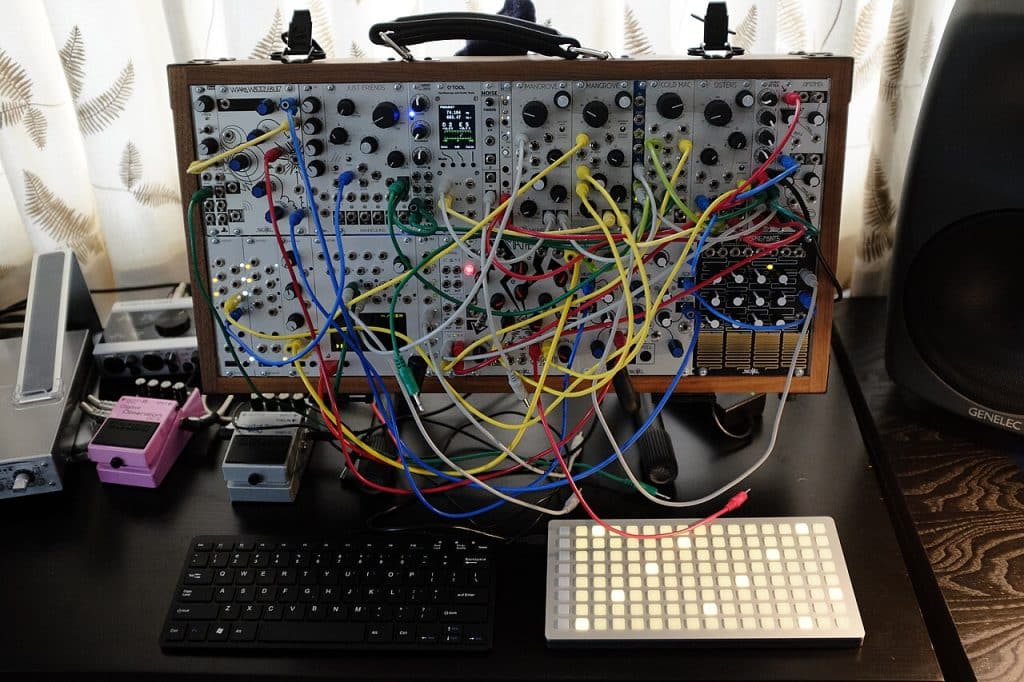
VCV Rack is a free, open-source program that simulates a Eurorack modular synthesizer on a computer. You add virtual modules to an empty rack, such as oscillators, filters, envelopes and sequencers, and connect them with virtual patch cables, just as you would with hardware. It runs on Windows, macOS and Linux, and a paid Pro edition also works as a plugin inside a DAW.
VCV’s GitHub page sums it up as “The virtual Eurorack studio”. The company is VCV, founded by developer Andrew Belt. As for the name, the VCV manual says “There is no official meaning of the name” and that it “was chosen simply because it is easy to remember and type” (VCV manual, FAQ). This entry is a neutral reference: what you get in each edition, how it maps to Eurorack, what is in the module library today, and how it developed.
- VCV Rack 2 Free is a standalone app, licensed under the GPL version 3 or later. Rack 2 Pro costs $149 and adds VST2, VST3, Audio Unit and CLAP plugins for DAWs.
- It follows Eurorack conventions: 1 V/oct pitch, 10 V gates, ±5 V audio and panel widths in HP. Its cables can carry up to 16 channels.
- In my census of the VCV Library on 9 November 2026, 503 plugins with 4,750 modules had a Rack 2 build, and 89.5% of those modules were free.
- 441 modules carry the “Hardware clone” tag. All 20 of VCV’s Audible Instruments modules are described as based on Mutable Instruments designs, and 18 of them carry the tag.
- The public beta came out at Knobcon in September 2017, version 1.0 in June 2019 and Rack 2 in November 2021. The current version is 2.6.6 from November 2025.
Rack 2 Free, Rack 2 Pro and VCV+
There are three ways to get it: a free standalone app, a paid Pro version that adds the DAW plugin, and a subscription that bundles Pro with premium modules. The prices below are the ones on vcvrack.com on 9 November 2026.
| Edition | Price | Runs as | What you get | Source |
|---|---|---|---|---|
| Rack 2 Free | Free | Standalone app (Windows, macOS, Linux) | Core and VCV Free modules, every free Library module; source code under GPLv3+ | vcvrack.com/Rack |
| Rack 2 Pro | $149 | Standalone plus VST2, VST3, Audio Unit (macOS only) and CLAP plugin | Everything in Free plus the VCV Pro modules; 16 audio in/out channels, MIDI, automation and offline rendering inside a DAW | VCV manual |
| VCV+ | $29 per month, or $19 per month paid yearly | Rack Pro plus premium modules | Rack Pro, all VCV-branded modules, official Eurorack ports and hundreds of premium third-party modules; premium modules go silent if the subscription ends | VCV+ page |
Rack 2 Free includes the Core modules (audio and MIDI interfaces) and the VCV Free collection, which VCV calls an “Essential synthesis toolkit” (VCV Free Modules). Its 37 modules include VCO, Wavetable VCO, VCF, VCA, LFO, Delay, ADSR EG, Mix, Scope, SEQ 3, Quantizer, Noise and Random. So the basics of a modular voice are there: oscillator, filter, VCA and ADSR envelope. VCV’s product page lists “30+ built-in modules with all the tools you need to get started” (VCV Rack 2).
Rack 2 Pro is the same program plus a VST and other plugin formats. The manual puts it this way: “VCV Rack Pro allows you to use Rack as a plugin in your DAW, as well as a standalone application.” The supported formats are VST2, VST3, CLAP and “Audio Unit (macOS only)”. Inside a DAW, “All Rack plugin formats include 16 audio input channels (8 stereo inputs) and 16 audio output channels (8 stereo outputs)”, plus MIDI in and out, parameter automation and offline rendering (VCV manual, Rack Pro Features). VCV writes “We test and support VCV Rack Pro in the following DAWs.” and names “Ableton Live, Cubase, FL Studio, Reason, Bitwig, Reaper, Mixbus, Studio One, Cakewalk, Logic Pro, and GarageBand”. Pro also includes the VCV Pro modules, which VCV describes as “Premium modules included in VCV Rack Pro”, among them VCV Chorus and VCV Flanger (VCV Pro Modules).
VCV+ launched in September 2024. VCV’s announcement gives the price as “$29/month” or “$19/month billed annually” and lists Rack Pro, “All VCV-branded modules:”, “Official virtual Eurorack modules:” (it names Synthesis Technology and ALM Busy Circuits) and “Hundreds of premium third-party modules by participating developers.” (VCV news, 7 September 2024). One condition is worth knowing before you build patches around it: if the subscription ends, “premium modules will emit silence unless your VCV+ subscription is renewed” (VCV+). Single purchases remain possible: “you can directly purchase VCV Rack Pro and premium modules on the VCV Library”.
How VCV Rack maps to Eurorack
Rack copies the conventions of Eurorack so that a patch on screen behaves like one in a hardware case. Its developer documentation tells module makers to follow hardware voltage levels, while admitting that “there are very few actual” standards in Eurorack (VCV manual, Voltage Standards). The main ideas map like this:
| Eurorack idea | How VCV Rack does it | VCV source |
|---|---|---|
| Control voltage (CV) | Modulation sources typically 0 to 10 V (unipolar) or ±5 V (bipolar); oscillators and CV generators typically 10 V peak to peak | Voltage Standards |
| Audio level | ±5 V before band-limiting; Eurorack power rails are −12 to 12 V | Voltage Standards |
| Gate and trigger | Gates are 10 V while on; triggers are 10 V pulses 1 ms long; trigger inputs use a Schmitt trigger with a low threshold of about 0.1 V and a high one of about 1 to 2 V | Voltage Standards |
| Pitch: 1 V/oct | 1 volt per octave, so 1/12 V per semitone; oscillators default to C4 (261.6256 Hz) at 0 V | Voltage Standards, VCV VCO manual |
| Panel size: HP | Panels are 128.5 mm high and a multiple of 5.08 mm (1 HP) wide | Panel Guide |
| Patch cables | Every cable adds a one-sample delay; one cable can carry up to 16 channels (polyphonic cables) | Voltage Standards, Polyphony |
| Mixing at an input | Since Rack 2.5, several cables stacked on one input are summed | Changelog 2.5.0 |
A few points in plain words:
- Control voltage (CV) is any signal that controls a parameter instead of being heard: an LFO moving a filter, an envelope opening a VCA. In Rack it is a number in volts, exactly like audio, so any output can patch into any input. This is the same freedom a modulation matrix gives a polysynth, done with cables.
- Gates and triggers carry timing. The manual says “Gates should produce 10 V when active.” and “Trigger sources should produce 10 V with a duration of 1 ms”. A MIDI-to-CV module turns a held key into such a gate: “GATE generates 10V when a key is held.” (VCV manual, Core Modules).
- V/oct carries pitch. “Modules should use the 1 V/oct (volt per octave) standard for CV control of frequency information.” Add 1 V and an oscillator goes up an octave; add 1/12 V and it goes up a semitone.
- HP (horizontal pitch) is the width unit. Developers are told to “Set the height to 128.5 mm” and use “a desired multiple of 5.08 mm” for the width (VCV manual, Panel Guide). On screen this only affects layout, but it makes Rack panels look like the real thing.
- Cables have one difference from hardware: “Each cable in Rack induces a 1-sample delay of its carried signal from the output port to the input port.” At 48 kHz that is about 0.02 ms per cable. For that reason VCV asks modules with clock and reset inputs that they “should ignore CLOCK triggers up to 1 ms after receiving a RESET trigger”.
The biggest departure from hardware is the polyphonic cable. Since version 1.0, one cable can carry several channels, and “It is recommended to support up to 16 channels, which is the maximum that Rack allows.” In the manual’s words, “monophonic cables are actually just a special case of polyphonic cables” (VCV manual, Polyphony). So a single chain of oscillator, filter and VCA can play eight or 16 notes at once, where, as the manual explains, without polyphonic cables “you would need to create” one copy of every module per voice.
The VCV Library in numbers: my census
Modules come packaged as plugins; the manual says “Plugins are typically installed via the” VCV Library. VCV’s FAQ defines a plugin as “a single software unit typically developed by one company or individual that can contain multiple VCV Rack modules”. To see what the Library holds today, I counted it on 9 November 2026 from two public sources: the VCV Library API, which flags each plugin as available for Rack 2, premium (paid) or open source, and the VCVRack/library database on GitHub, which lists every module with its tags. I matched the two by plugin slug and, for everything below, counted only modules that are not hidden or deprecated.
The database has 605 plugin entries listing 5,204 modules, hidden and deprecated ones included. 102 of those plugins have no Rack 2 build, all of them added between 2018 and 2021. Without them, and without hidden or deprecated modules, there are 503 plugins with 4,750 modules from 386 brands that you can install in Rack 2 today. VCV’s own product page still says “2000+ modules available on the VCV Library”, which understates the current count: my figure is about 2.4 times that. For comparison, Stanford’s CCRMA described “over 1,200 modules currently available” in July 2019, and Engadget wrote on 1 December 2021, the day after the Rack 2 launch, that “VCV has a library of almost 2,700 modules” (Engadget).
Free vs paid modules
Nearly nine in ten modules cost nothing. 399 of the 503 Rack 2 plugins are free and hold 4,250 modules, or 89.5% of the total. 350 of the free plugins are open source (3,790 modules); the other 49 are closed-source freeware. 104 plugins are paid, with 500 modules between them; none of the 104 paid plugins in my census is flagged open source. Prices are set per plugin; the Doepfer A-124 Wasp filter, for example, costs $15 in the Library (Doepfer listing).
The licence sets the rules for this split (see below). A plugin may use any licence as long as it is given away; selling one needs a commercial licence from VCV, which is included when the plugin is sold through the VCV Library.
What the modules do
Developers tag their modules by function. The most common tags are Polyphonic, Utility and Sequencer; Oscillator is fourth and Filter twelfth. Tags are self-declared, so treat this as a rough map. About 34% of all modules (1,600) are tagged polyphonic.
New plugins keep arriving. Counting Rack 2 plugins by the year their Library entry was created, 2026 already has 115 new entries by 9 November, more than twice the 47 of 2025 and the highest of any year in the data. I can’t tell from the data why; it only records when each entry was added. Almost all plugins (490 of 503) also have a native build for Apple Silicon Macs.
Ports of real hardware modules
441 of the 4,750 modules (9.3%) carry the “Hardware clone” tag, which developers use for modules modelled on a real hardware module. One prominent group is VCV’s own Audible Instruments. It has the highest popularity score in the Library API (243,963) and is a free plugin under “GPL-3.0-or-later” with “20 modules in plugin”. The Library describes them one by one as “Based on Mutable Instruments Braids”, “Based on Mutable Instruments Plaits”, “Based on Mutable Instruments Rings” and so on (Audible Instruments listing); 18 of the 20 carry the hardware tag.
Mutable Instruments’ source code is public: per its repository, “Code (STM32F projects): MIT license.” and “Code (AVR projects): GPL3.0.” (pichenettes/eurorack). Mutable Instruments itself “has shut down in December 2022” (Mutable Instruments), while the Audible Instruments ports remain free to install. The Audible Instruments README also lists modules that are “Not yet ported”. For the techniques behind Rings and Clouds, see my entries on physical modeling synthesis and granular synthesis, and for the wider topic my article on open-source synths.
Other ports are official and paid. Doepfer’s A-124 Wasp filter is “Modeled from the Doepfer A-124 hardware module” (VCV, Doepfer), and ALM Busy Circuits’ Pamela’s PRO Workout “is now available in virtual form for the VCV Rack software platform.” at launch in October 2023, “available now, priced at $20.” (Sound On Sound). The VCV+ page names two approaches for premium hardware ports: “Run original firmware of digital hardware on your computer.” and “Simulate circuitry of analog modules.” Unofficial copies are limited by VCV’s own rules for the Library: “You may not clone the brand name, model name, logo, panel design, or layout of components (knobs, ports, switches, etc) of an existing hardware or software product without permission from its owner” (VCV manual, Plugin Licensing). Among the hardware-tagged modules, the largest groups by the plugin’s Library brand were nozoïd (47), Befaco (35) and Instruō (28).
A caveat on all these numbers: they count what developers declare. A module tagged “Hardware clone” is not necessarily licensed by the hardware maker, and VCV’s licensing page also mentions “Donationware”. I kept the script and the dated results, so the census can be repeated later.
History and versions
It started as one developer’s project. “Andrew Belt founded VCV as a side-project in 2016” (Stanford CCRMA), and according to the VCV manual, “It was based on an unreleased C++ modular audio engine written by Andrew in 2012.” (VCV manual, About). The public start came in September 2017, when, as FACT put it, Rack was “launched at Chicago’s Knobcon event” (FACT). Synthtopia reported that “developers launched VCV Rack”, “an open-source virtual Eurorack modular synthesizer”, with “virtual versions of modules from Mutable Instruments, Befaco and Synthesis Technology” (Synthtopia, 11 September 2017).
| Date | Version or event |
|---|---|
| 14 Nov 2016 | The VCVRack/Rack repository is created on GitHub (Andrew Belt founded VCV as a side project that year, per Stanford CCRMA) |
| 10 Sep 2017 | Version 0.3.0, the public beta, is released at Knobcon 2017 |
| 29 Mar 2018 | Version 0.6.0 adds VCV Bridge, effect plugins for using Rack as a send/return on a DAW track |
| 19 Jun 2019 | Version 1.0.0 adds polyphonic cables, multithreading and MIDI output modules |
| 30 Nov 2021 | Rack 2.0.0 and the paid Rack Pro (VST2 plugin; $99 introductory, then $149) |
| 23 Nov 2022 | Rack 2.2.0 adds VST3, Audio Unit and CLAP plugin adapters to Rack Pro |
| 8 Apr 2024 | Rack 2.5.0 allows stacking several cables on one input (their voltages are summed) |
| 7 Sep 2024 | VCV+ subscription launches ($29 per month, or $19 per month billed yearly) |
| 14 Mar 2025 | Rack 2.6.1 adds UI translations into six languages |
| 4 Nov 2025 | Rack 2.6.6, the current version on 9 November 2026 |
Two releases brought the biggest changes. Version 1.0 (June 2019) brought polyphonic cables; CDM wrote at the time that “Modules that want to support polyphony now can add up to 16 voices.” (CDM). Rack 2 (November 2021) split the product into Free and Pro. CDM reported that “the Pro version will be US$99 at launch through the end of this year.” and “That price will then go up to US$149 regular pricing.” It also noted that “at launch Rack 2 is available Intel-native, and with VST2 plug-in support.” (CDM, 30 November 2021). The other plugin formats followed a year later: version 2.2.0 says “Add VST3, Audio Unit, and CLAP plugin adapters.” (official changelog). Before Rack 2, VCV’s DAW link was VCV Bridge (version 0.6.0, 2018), “for interfacing Rack with your DAW” through send/return effect plugins.
Licence: GPLv3 and the plugin exception
The free edition is open source. Its source code is released under the GNU General Public License, “either version 3 of the License, or (at your option) any later version” (LICENSE.md on GitHub). The source sits in the VCVRack/Rack repository, written in C++. The Library API lists Rack Pro’s module plugin, VCV Pro, as proprietary, and none of the 104 paid plugins in my census is flagged open source.
The licence has an exception for plugins. They can use Rack’s API under any licence they like, “provided that the Plugin is distributed free of charge”. Paid plugins need a commercial licence, and “A commercial license is included for plugins sold on the” VCV Library. Two smaller points from the same file: the component library graphics are licensed “CC BY-NC 4.0”, and the name “VCV” “is trademarked and may not be used for unofficial products”, although “it is acceptable to use the phrase” “for VCV Rack” when promoting a plugin.
System requirements
Rack 2 runs on modest hardware but is picky about graphics. VCV lists these requirements (Rack 2 system requirements):
- Operating system: “Windows 7+, macOS 10.9+, or Linux (such as Ubuntu 16.04+)”.
- CPU: “Intel/AMD 64-bit processor (x64) supporting SSE4.2 (2011 or later), or Apple M1 (ARM64) or higher”.
- Graphics: a “Dedicated Nvidia/AMD graphics card from 2013 or later”. VCV warns that “Integrated (non-dedicated) graphics such as Intel HD are not recommended” and “may cause significantly increased CPU usage”.
- Memory and disk: “Memory: 1 GB” and “Disk space: 1 GB”.
CPU load depends mostly on the patch. Polyphonic modules help here: compared with separate mono copies, the manual puts the saving “often as high as 4x (25% the CPU)”. In Pro, offline rendering takes the pressure off for long pieces: “if your Rack patch uses about 10% CPU, a 10 minute song can be rendered in just 1 minute”.
How people use VCV Rack
- Learning modular synthesis. Rack Free costs nothing, so you can learn how a modular voice is built without buying hardware: oscillator into filter into VCA, with an envelope and an LFO for movement. That is classic subtractive synthesis, but you patch every connection yourself. For wavefolding and other distortion, my census found 145 modules tagged Waveshaper.
- Using ports of hardware modules. Some modules reproduce a hardware module, for example the Wasp filter, “Modeled from the Doepfer A-124 hardware module”.
- A modular inside the DAW. With Pro, Rack loads in your DAW, with up to 16 audio channels each way, MIDI and automation; “All Rack plugin formats can be used as an instrument and effect (FX) plugin.” The reverse is possible too: VCV’s own Host module lets you “Host VST plugins inside Rack and control parameters with CV using VCV Host (purchased separately)”.
- Hybrid setups with hardware. The Core Audio module “merges the virtual Rack world with the physical hardware world.” For MIDI gear there is CV-MIDI, which “Converts CV in Rack to MIDI for external hardware.” To send real control voltages to a Eurorack case you need a DC-coupled audio interface. As Sound On Sound explains, “Most audio interfaces have what is called AC-coupled outputs, where a capacitor is used to filter out the extreme low frequencies.” and “This is a disaster for CV, as it cannot output the sort of slow-moving or static values we need.” Outputs that skip this filter “are described as DC-coupled” (Sound On Sound, Modular Interfacing). Expert Sleepers’ ES-8, for example, is a Eurorack module “with DC-coupled inputs and outputs that can be used for both CVs and audio.” (Expert Sleepers), and the company’s Rack plugin page describes one that “provides a means to adjust for the voltage response of uncalibrated DC-coupled audio interfaces” (Expert Sleepers, VCV Rack plug-ins). For a computer-free hardware rig, see my entry on dawless setups.
- Sound design and generative music. Random, logic and sequencer modules make up a large part of the Library, which suits patches that play themselves. Rack can even run headless: the manual describes a command-line flag that “Launches the autosaved patch with no window.” (VCV manual, Installing & Running). My sound design entry covers the general techniques.
- Writing your own modules. VCV invites it: “Develop your own modules with the C++ VCV SDK”.
Frequently asked questions
Is VCV Rack free?
Yes. VCV Rack 2 Free is a free download and includes the Core and VCV Free modules. Rack 2 Pro, which adds the DAW plugin, costs $149, and the VCV+ subscription costs $29 per month or $19 per month billed yearly. In my November 2026 census, 89.5% of the Library modules available for Rack 2 were free.
Is VCV Rack open source?
The free edition is: its source code is on GitHub under the GNU GPL, version 3 or later, with an exception that lets free plugins use any licence. The Library API lists the VCV Pro plugin as proprietary. In my census, 350 of the 503 Rack 2 plugins were free and open source, and none of the paid ones was.
Can VCV Rack run as a VST plugin in a DAW?
Only the paid Rack 2 Pro edition. It runs as a VST2, VST3, CLAP or, on macOS, Audio Unit plugin, usable as an instrument or an effect, with 16 audio inputs, 16 audio outputs, MIDI and parameter automation. Rack 2 launched in November 2021 with VST2 only; the other formats arrived in version 2.2.0 in November 2022.
How many modules does VCV Rack have?
Rack 2 Free ships with the Core modules plus 37 VCV Free modules. The VCV Library holds far more: on 9 November 2026 I counted 503 plugins with 4,750 modules that have a Rack 2 build. 4,250 of those modules were free, and 500 came in 104 paid plugins.
What are the system requirements for VCV Rack 2?
VCV lists Windows 7 or later, macOS 10.9 or later, or Linux, and a 64-bit Intel or AMD CPU with SSE4.2 from 2011 or later, or an Apple M1 or newer. It asks for 1 GB of memory, 1 GB of disk space and a dedicated graphics card from 2013 or later.
Can VCV Rack control a hardware Eurorack synth?
Yes. Its Audio module sends any signal, including CV, to an audio interface, but the outputs must be DC-coupled, because most interfaces filter out slow voltages. A Eurorack interface such as the Expert Sleepers ES-8 works. For MIDI gear, the CV-MIDI module converts voltages to MIDI. Rack uses 1 V/oct pitch and 10 V gates.
Back to Music Production Terms Index Page